BIEK Part-I 2026: What "Ungraded" Means and What to Do Next

For many BIEK Part-I students, the most confusing word on the 2026 result is not fail but ungraded. Under the new grading system introduced for this examination, a student who scores under 40% in any paper is recorded as ungraded in that paper, which means the candidate is unsuccessful in that paper and reappears in it subject to eligibility. The word is new, the rule is new, and the consequences are widely misunderstood, with some students assuming an ungraded paper is a minor technicality and others fearing it ends their intermediate studies. Neither is true. This guide explains exactly what ungraded means, how it differs from the old fail, what your options are, and how to build a Part-II plan that deals with open papers instead of ignoring them.
What "Ungraded" Actually Means
Under the new grading system, decided by the Inter Board Coordination Commission together with the Sindh Universities and Boards Department, the pass threshold for a paper is 40%. A mark below 40% does not earn a grade in that paper at all, which is why the result shows it as ungraded rather than with a low grade. The practical meaning is straightforward: you have not passed that paper, and you must reappear in it subject to eligibility. The word is not a punishment and not a comment on your other papers; each paper is judged separately, so an ungraded mark in one subject does not cancel passes in your other subjects.
The change from the old system matters because students and parents still think in terms of the old 33% threshold. Under the old rule, a mark of 35% or 37% would have been a pass, though a low one; under the new rule, the same mark is ungraded. That single shift explains a large part of the lower full-pass rates across the BIEK groups this year, and it is why comparing a 2026 result with an older sibling's result mark-for-mark is misleading. The standard has moved, and students need to judge their marks against the 40% line, not against the expectations of previous years. The solved notes can help you revise the exact chapters behind an ungraded paper.
Ungraded Versus Failed: Is There a Difference?
In everyday language, students use failed and ungraded interchangeably, but the new terminology carries a specific meaning that is worth understanding. In the old scheme, a paper below the pass mark was simply a fail; in the new scheme, below 40% means no grade is awarded for that paper, which is why the board uses the term ungraded. For the student's next steps, however, the practical consequence is the same in the important respect: the paper is not passed and must be reappeared in. Students should not treat ungraded as softer than a fail, because the board treats it as an unsuccessful paper that needs to be cleared.
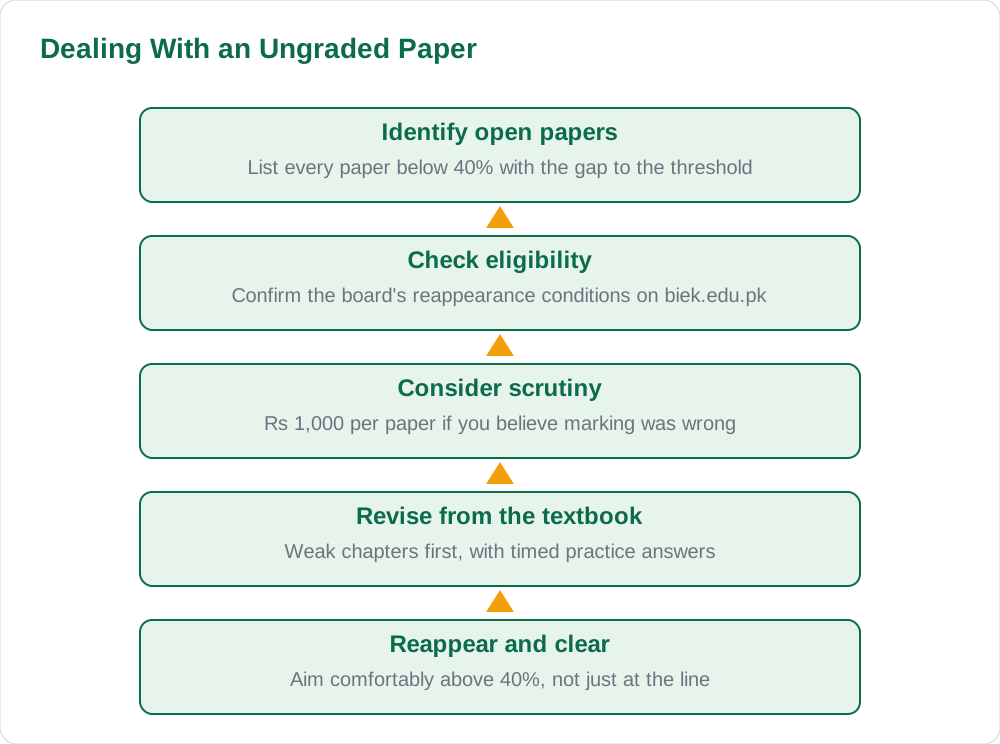
Where the new system does differ is in how it frames the rest of your result. Because grading is paper by paper, your passed papers keep their grades, and only the ungraded papers are open. This is genuinely useful information: instead of a vague sense of having failed the year, you have a precise list of papers to clear, and that list is usually much shorter than the full set. A student with one ungraded paper has a very different task from a student with four, and the first step in both cases is the same — write down the open papers, the marks obtained, and the gap to 40% for each one, so the work ahead is measured rather than feared.
Reappearing: Eligibility, Timing, and Preparation
The board's rule states that an ungraded candidate reappears in the paper subject to eligibility, which means you should confirm the eligibility conditions from the board's own notice rather than assuming them. Eligibility typically depends on your registration and on the examination cycle in which reappearance is offered, and the board announces the procedure, fee, and dates through its official channels. No reappearance date for BIEK Part-I ungraded papers is stated in the release reporting used for this guide, so this article does not invent one; check biek.edu.pk and your college notice board for the official announcement, and beware of social media posts that claim a date the board has not published.
Preparation for a reappearance should start before the notice arrives, because the gap between announcement and examination is often short. Rebuild the paper from your textbook, chapter by chapter, and give extra time to the chapters where you lost the most marks, which you can identify from your own sense of the paper and your teacher's advice. Practise writing full answers under time, since many ungraded marks come from incomplete answers and poor time management rather than from total ignorance of the subject. Ask your subject teacher to mark one or two practice papers, because a teacher's eye will catch the presentation and completeness problems that self-study misses. More revision strategies are on the blog.
Scrutiny: When It Helps and What It Costs
Scrutiny, sometimes called rechecking, is the formal route for a student who believes a paper has been marked wrongly — for example, if marks were not added correctly or a question was left unmarked. The BIEK scrutiny fee is Rs 1,000 per paper, as shown on the board's scrutiny form. Scrutiny is not a re-examination and it does not guarantee a changed result; in many cases the original marks stand, and the student has paid the fee and learned that the marking was correct. It is worth using when you have a specific reason to doubt the marking, such as a total that does not add up or a paper you were confident about returning a surprisingly low mark, but it is not a substitute for preparing to reappear.
One important caution: no scrutiny deadline is stated in the board's release reporting used for this guide, so do not rely on a deadline quoted by friends or social media. Confirm the last date from the board's own scrutiny notice or your college, and apply well before it if you decide to apply at all. Applying for scrutiny and preparing for reappearance are not mutually exclusive; a sensible student can do both, revising for the paper while the scrutiny application is processed, so that no time is lost if the marks remain unchanged. Keep the receipt for any scrutiny fee you pay, and keep your mark sheet and admit card safe throughout. The book collection covers the textbooks you will revise from.
Planning Part-II With Open Papers
The hardest part of an ungraded result is psychological: Part-II is starting, and the open Part-I papers can feel like a weight dragging behind you. The practical solution is a combined timetable. Give Part-II its proper share, since it is a full new year of study, but protect regular weekly slots for the open Part-I papers, with the paper closest to 40% first so you can clear it soonest. Many Part-I and Part-II chapters are linked, especially in the sciences, so revising a Part-I chapter often deepens the Part-II chapter built on it, and that overlap should be used deliberately rather than treated as a coincidence.
Talk to your teachers early about your open papers. They can tell you which chapters mattered most in the paper you missed, whether extra classes are available, and how to sequence your reappearance with Part-II examinations. Tell your parents too, so the study plan has support at home instead of becoming a secret source of stress. And keep perspective: an ungraded paper in Part-I is a common outcome under the new 40% rule — the group figures show full-pass rates below half in every BIEK group this year — and thousands of students clear such papers every year and complete their intermediate studies without lasting damage. The paper is open, not the door closed. The [home page](/) gathers further guides for intermediate students.
AI Help: Muse AI
Muse AI is Meta's personal AI assistant. You can ask it to explain a concept in simple words, summarise a lesson, or make practice questions for revision.
For an ungraded paper, you can ask Muse AI to explain the chapters you found hardest in simple words and to make short practice questions on them, then check every answer against your textbook and your teacher.
Join Muse with invite code LTGSWD — in the Muse app, go to Settings > Redeem token and enter the code.
Disclosure: LTGSWD is the author's Muse invite code.
Muse AI does not give official STBB answers — always verify against your Sindh Textbook Board book and your teacher.
5 key points you must know
- Under 40% in a paper means ungraded: no grade awarded, and the paper must be reappeared in.
- The old 33% threshold no longer applies; judge every mark against the 40% line.
- Ungraded affects only that paper; your passed papers keep their grades.
- Scrutiny costs Rs 1,000 per paper; confirm the deadline from the board's own notice.
- Plan Part-II and open Part-I papers as one timetable, starting with the smallest gap.
Frequently asked questions
What does ungraded mean on my BIEK Part-I result?
It means you scored under 40% in that paper, so no grade is awarded for it and you are unsuccessful in that paper. You must reappear in it subject to eligibility, as stated in the board's new grading rule.
Is ungraded the same as failing the whole year?
No. Grading is paper by paper, so an ungraded mark affects only that paper. Your passed papers stand, and your task is to clear the specific open papers, not to repeat the whole year.
I scored 37% in one paper. Did I pass it?
No. Under the new rule the pass threshold is 40%, so 37% is ungraded even though it would have passed under the old 33% threshold.
How much does BIEK scrutiny cost?
The scrutiny fee is Rs 1,000 per paper. Confirm the last date from the board's own notice, since no scrutiny deadline is stated in the release reporting used here.
Should I prepare for reappearance even if I apply for scrutiny?
Yes. Scrutiny often leaves marks unchanged, so revise for the paper while your application is processed. That way no time is lost whichever way the scrutiny goes.
Solved notes — preview free
These guides work best with the solved exercises. Preview the solved notes free on this website — 119 solved notes for Classes 6–10 in Sindhi, Urdu, English and Arabic medium. Or browse the full solved notes catalogue for your class and medium. New solved notes are added regularly — check the catalogue for coming-soon books.