BIEK Part-I Result 2026 Complete Guide: All Groups, Figures and How to Check
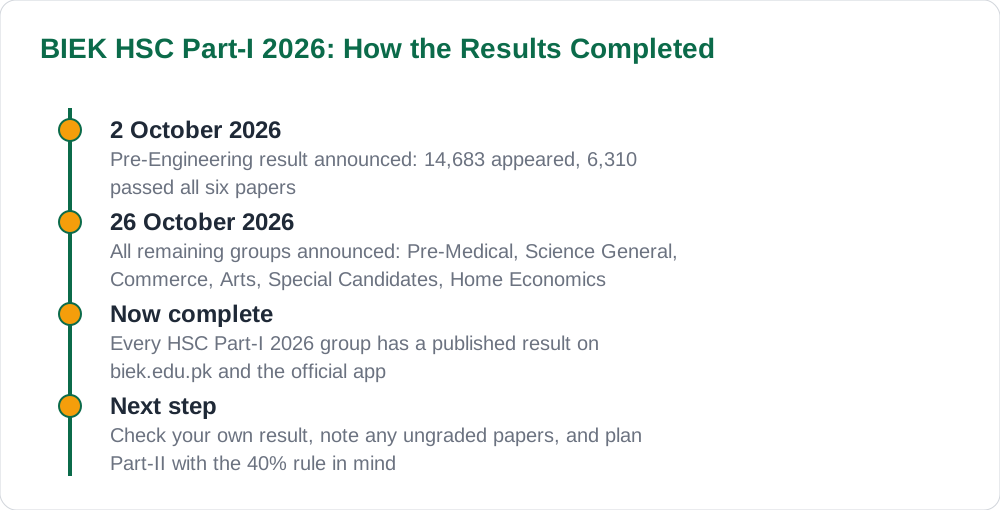
The Board of Intermediate Education Karachi completed its HSC Part-I (Class XI) Annual Examination 2026 results on Monday, 26 October 2026, when it announced the results for all remaining groups under Press Release No. BIEK/PR/152/2026, issued on the instructions of Chairman Faqir Muhammad Lakho and signed by Controller Zarina Rashid. With this announcement, every group of the 2026 first-year examination now has a published result, following the earlier Pre-Engineering announcement of 2 October 2026. This guide brings the whole picture together: the groups announced, the official figures for each group, how to check your result online and on the official app, and how the online result differs from the gazette. It uses only the figures from the board's release as reported, so students can rely on the numbers here.
Which Groups Were Announced on 26 October
The 26 October announcement covered six groups: Science Pre-Medical, Science General, Commerce (Regular and Private), Humanities and Arts (Regular and Private), Special Candidates (Arts Regular), and Home Economics. These were the groups still outstanding after Pre-Engineering, whose result had already been announced on 2 October 2026 with 15,044 registered, 14,683 appeared, and 6,310 students passing all six papers. Students sometimes confuse the two announcements and look for their group in the wrong one, so the first check is simple: if your group is Pre-Engineering, your result dates from 2 October; every other group dates from 26 October. Both announcements belong to the same HSC Part-I Annual Examination 2026, and both are available through the same official channels.
The distinction between Regular and Private matters within Commerce and Arts, because the board publishes separate figures for each stream. Commerce Regular and Commerce Private are different cohorts with different totals, and Arts Regular and Arts Private likewise, so a student should always match their result to their own stream rather than to the other stream's figures. Special Candidates (Arts Regular) is a small separate cohort, and Home Economics is the smallest group of all. Knowing which cohort you belong to prevents the common error of comparing your result with the wrong group's pass rate and drawing the wrong conclusion about your own performance.
The Full Group Figures
Pre-Medical, the largest group, had 25,157 registered and 24,544 appeared, with 11,966 students passing all six papers, which is 48.75% of those who appeared. Science General followed closely with 30,991 registered, 30,386 appeared, and 15,036 passing all six papers, or 49.48% of appeared students. Commerce Regular recorded 23,549 registered, 22,693 appeared, and 9,332 passing all seven papers (41.12%), while Commerce Private had 1,485 registered, 1,413 appeared, and 628 passing all seven (44.44%). The seven-paper total for Commerce reflects its subject combination, and students should not compare a seven-paper pass directly with a six-paper pass in another group without noting that difference.
In the Arts groups, Arts Regular had 11,171 registered, 10,678 appeared, and 3,748 passing all six papers (35.10%), while Arts Private had 1,702 registered, 1,623 appeared, and 692 passing all six (42.63%). Special Candidates (Arts Regular) recorded 99 registered, 97 appeared, and 58 passing all six, using the Tribune's figures for this small cohort. Home Economics, the smallest group, had 146 registered, 141 appeared, and 41 passing all seven papers (29.07%). Read together, the figures show that no group reached a full-pass rate above half the appeared students, and that the spread between the highest group (Science General at 49.48%) and the lowest (Home Economics at 29.07%) is wide — a reminder that each group's result reflects its own subjects and cohort. For revision help in any of these subjects, see the book collection and the solved notes.
How to Check Your Result
Results are available on the board's official website, biek.edu.pk, and through the official BIEK Android app. To check online, open the website, find the HSC Part-I Annual Examination 2026 result section, and enter your roll number exactly as printed on your admit card, including any leading zeros. Check the name, group, and stream shown on the result before reading the marks, because a mistyped roll number can display another student's result and cause unnecessary panic. If the website is slow on the first day of a result, wait and retry rather than trusting a third-party site that may show incomplete or outdated data.
The official app is the board's own application, and it is the safer alternative to unofficial result apps that sometimes carry advertising or stale data. Download it only from the official store listing linked by the board, and enter the same roll number details as on the website. If the app and the website disagree, trust the website result and, if the difference matters, confirm with your college or the board's result section, since the online display is provisional in any case. Keep a screenshot or printout of your result for your own records, but remember that it is not a substitute for the official mark sheet your college will issue. More board-result guides are on the blog.
Online Result Versus Gazette
Students often ask whether the online result or the gazette is the real one, and the answer is that they serve different purposes. The online result is fast and personal: it shows your own marks within hours of the announcement and lets you plan immediately. The gazette is the board's complete published record of the examination, listing results in roll-number order, and it is the document colleges and the board itself refer to when a discrepancy is raised. If your online result and the gazette ever differ, the gazette and the official mark sheet carry the authority, and you should raise the matter through your college or the board's scrutiny and correction process rather than arguing from a screenshot.
The gazette is also useful for context that an individual result cannot give. It lets a student see how their group performed overall and confirms the group figures quoted in this guide, which come from the board's release. However, the gazette is a large document and searching it takes patience, so most students will use the online result for their own planning and turn to the gazette only if something looks wrong. Either way, no position-holder or topper names for the BIEK 2026 Part-I results were published in the sources for this guide, so lists of toppers circulating online should not be treated as official unless the board itself publishes them.
What Comes Next After Part-I
Part-I is only the first half of the intermediate qualification, and the most important thing it determines is your starting point for Part-II. Under the new grading system, scoring under 40% in any paper means you are ungraded in that paper and reappear in it subject to eligibility, so students with ungraded papers should deal with them deliberately rather than hoping Part-II marks will somehow cover them. Part-II preparation should also be planned around the 40% standard from the start, since the same threshold applies there. Students who passed all Part-I papers can focus entirely on Part-II, while students with open papers need a combined plan that revises the open papers alongside new Part-II chapters.
Two practical habits will serve every Part-I student well. First, collect and file your official mark sheet when your college issues it, and keep your admit card and registration details with it, because Part-II forms and any scrutiny application will ask for them. Second, if you believe a paper has been marked wrongly, use the board's formal scrutiny route — the scrutiny fee is Rs 1,000 per paper — rather than informal complaints, and note that no scrutiny deadline is stated in the board's release reporting used here, so confirm the deadline from the board's own notice before assuming one. Planning Part-II early, while the Part-I syllabus is still fresh, is the single best use of the weeks after this result. The [home page](/) links to further study guides for first- and second-year students.
AI Help: Muse AI
Muse AI is Meta's personal AI assistant. You can ask it to explain a concept in simple words, summarise a lesson, or make practice questions for revision.
After a big result announcement, you can ask Muse AI to help you organise your next steps, for example by drafting a weekly study timetable that covers both your Part-II chapters and any Part-I papers you still need to clear.
Join Muse with invite code LTGSWD — in the Muse app, go to Settings > Redeem token and enter the code.
Disclosure: LTGSWD is the author's Muse invite code.
Muse AI does not give official STBB answers — always verify against your Sindh Textbook Board book and your teacher.
5 key points you must know
- BIEK completed HSC Part-I 2026 on 26 October 2026; Pre-Engineering dated from 2 October.
- Pre-Medical: 11,966 of 24,544 appeared passed all six papers (48.75%).
- Science General had the highest full-pass rate at 49.48%; Home Economics the lowest at 29.07%.
- Check results on biek.edu.pk or the official BIEK Android app using your exact roll number.
- The gazette and official mark sheet outrank the online display if any difference appears.
Frequently asked questions
When were the BIEK HSC Part-I 2026 results announced?
Pre-Engineering was announced on 2 October 2026, and all remaining groups — Pre-Medical, Science General, Commerce, Arts, Special Candidates and Home Economics — were announced on 26 October 2026 under Press Release No. BIEK/PR/152/2026.
How do I check my BIEK Part-I result?
Visit biek.edu.pk or use the official BIEK Android app and enter your roll number exactly as printed on your admit card. Check that the name, group and stream shown match your own details before reading the marks.
What is the difference between the online result and the gazette?
The online result is the fast, personal display of your marks. The gazette is the board's complete published record in roll-number order, and together with the official mark sheet it carries authority if any discrepancy arises.
Why do Commerce and Home Economics students need seven papers to pass fully?
Their subject combinations include seven papers, while Pre-Medical, Science General and Arts have six. A full pass means passing all papers in your own combination, so compare your result only within your own group.
What should I do if I think a paper was marked wrongly?
Use the board's formal scrutiny route; the scrutiny fee is Rs 1,000 per paper. Confirm the deadline from the board's own notice, since no scrutiny deadline is stated in the release reporting used here.
Solved notes — preview free
These guides work best with the solved exercises. Preview the solved notes free on this website — 119 solved notes for Classes 6–10 in Sindhi, Urdu, English and Arabic medium. Or browse the full solved notes catalogue for your class and medium. New solved notes are added regularly — check the catalogue for coming-soon books.