How BIEK Marks Science Papers: E-Assessment, OMR and E-Marking Explained
When BIEK announced the HSC Part-I results for the remaining groups on 26 October 2026, one technical detail stood out for science students: science-group optional subjects are assessed through E-Assessment, using OMR and E-Marking. Many students have heard these terms without knowing what they actually mean, and some worry that a machine decides their marks. This guide explains the system in plain language: what OMR sheets are, how E-Marking works, what it changes for students, and how to fill an OMR sheet correctly so that technology records the answers you actually intended. No part of this guide guesses at board procedures beyond what has been verified; where the board has not published a detail, this guide says so.
What E-Assessment Means for Science Students
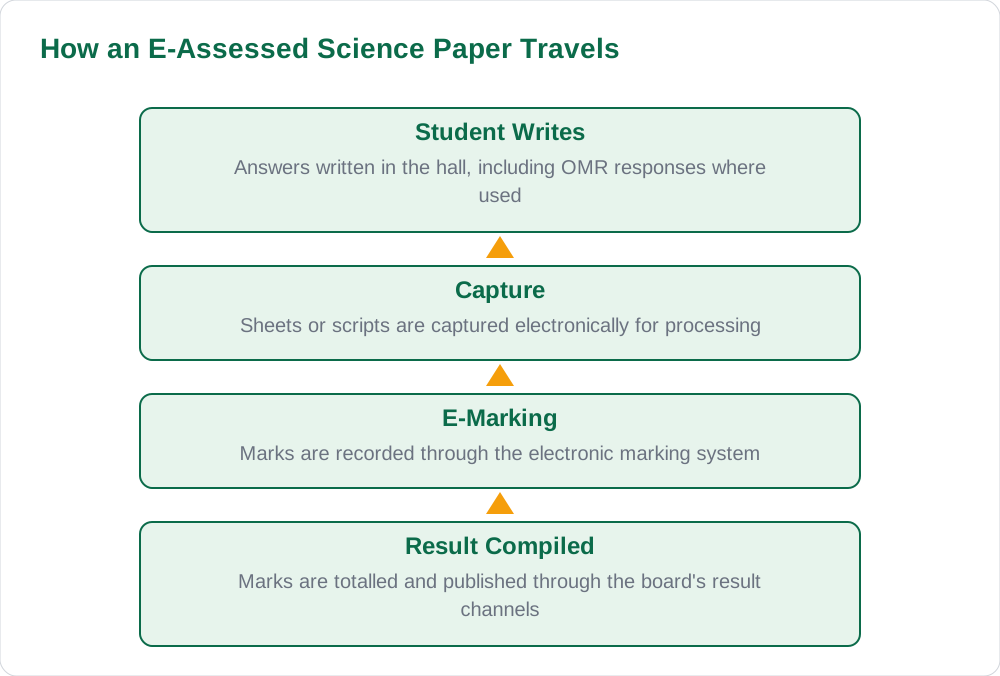
E-Assessment means that parts of the assessment process are handled electronically rather than entirely on paper. For BIEK's science-group optional subjects, the verified fact is that assessment runs through E-Assessment with OMR and E-Marking, and that fact was noted in the board's 26 October 2026 announcement for the remaining HSC Part-I groups, which included Science Pre-Medical and Science General. The practical meaning for students is that their answers in the affected subjects pass through a digital stage, whether that is machine reading of an answer sheet or on-screen marking of scanned scripts, rather than every step happening by hand on paper alone.
Students should understand that E-Assessment is a method of processing, not a different syllabus or a different standard. The questions, the marking scheme, and the knowledge required are the same; what changes is how answers are captured and checked. That distinction matters because it answers the most common worry: the system does not invent marks or change the difficulty of the paper. It records and processes what the student wrote, and the student's job remains what it always was, to write correct, complete answers. The verified context here is the 26 October announcement itself, and students should not assume details about the system that the board has not published.
OMR Sheets: What They Are and Why They Need Care
OMR stands for Optical Mark Recognition, and an OMR sheet is an answer sheet on which students darken bubbles or marks to indicate their choices, usually for objective or multiple-choice questions. A machine reads the darkened marks, which makes the capture of objective answers fast and consistent, and removes the variation that comes from different people reading handwriting. For science students, OMR is most relevant to the objective sections of their papers, where a single darkened bubble carries the answer, and where a careless mark can therefore cost a mark just as surely as a wrong answer.
The care OMR requires is simple but strict: darken the chosen bubble completely, use the writing instrument the instructions specify, avoid stray marks on the sheet, and never darken two bubbles for one question. Students should also double-check the question number against the bubble row before darkening, because a slipped row, answering question 12 in row 13, is one of the most common and most avoidable OMR errors. Reading the sheet's instructions before starting, rather than assuming they match a previous paper's, is part of the discipline, because formats can differ between subjects and sessions.
E-Marking: What Happens After the Paper
E-Marking means that marking is carried out through an electronic system, in which scripts or answer data are presented to markers on screen, and marks are entered digitally rather than written by hand on paper. The advantage is consistency and traceability: marks are recorded in a structured way, totals can be checked by the system, and the path from a marked answer to a published result has fewer manual transcription steps. For students, the practical consequence is that the system is designed to reduce the very errors, missed totals and wrong transfers, that the scrutiny process exists to catch.
It is important not to overclaim what E-Marking guarantees. It does not mean a paper is marked by a machine instead of a human examiner, and this guide does not claim that, because the board's verified statement is that science-group optional subjects are assessed through E-Assessment with OMR and E-Marking, without publishing a fuller procedural breakdown. What can fairly be said is that electronic capture and entry reduce transcription risk and make the checking process more systematic. Students who want the board's own detail should look to BIEK's official announcements rather than to unofficial explanations that invent steps the board has not described.
How Students Should Prepare for E-Assessed Papers
Preparation for an E-assessed paper is mostly the same as for any paper, with a few extra habits for the objective sections. First, practise objective questions regularly, because multiple-choice and short objective items reward quick, accurate recall, and a student who only practises long answers may be slow on the objective section. Second, practise filling a sample OMR-style sheet if one is available from school or college, so that the real sheet feels familiar rather than strange. Third, during the paper, keep track of time separately for the objective and subjective sections, so that neither is starved by the other.
Fourth, keep written answers neat and complete even where marking is electronic, because scanned scripts must still be readable, and a cramped or faint answer helps nobody. Fifth, attempt every objective question unless the instructions penalise guessing, because an unanswered question is a certain zero while an attempted one has a chance. These habits are small, but together they protect the marks a student has earned through study, which is exactly what an assessment system, electronic or otherwise, is meant to record. Further study material is available on Solved Notes and Books.
E-Assessment and the 26 October Results in Context
The E-Assessment note belongs to a specific announcement: the HSC Part-I results for remaining groups on 26 October 2026, announced by Controller of Examinations Zarina Rashid under Chairman Faqir Muhammad Lakho, covering Science Pre-Medical, Science General, Commerce (Regular and Private), Arts (Regular and Private), Special Candidates (Arts Regular), and Home Economics. The verified figures from that announcement include Pre-Medical with 25,157 registered, 24,544 appeared, and 11,966 passing all six papers, and Science General with 30,991 registered, 30,386 appeared, and 15,036 passing all six. Pre-Engineering had already been announced on 2 October 2026, and results are available on biek.edu.pk and the official BIEK Android app.
The same announcement introduced the new grading under which under 40 percent in any paper means ungraded, not passed in that paper, and students reading those results should keep the two facts separate: E-Assessment describes how papers are processed, while the 40 percent rule describes the standard for passing. Confusing the two leads to wrong conclusions, such as blaming a result on the marking method when the standard is the actual cause, or vice versa. Keeping method and standard distinct is part of reading board announcements accurately, and it helps students direct their effort correctly, towards stronger preparation rather than suspicion of the system. More board result guides are on Blog.
AI Help: Muse AI
Muse AI is Meta's personal AI assistant, and it can help you prepare for E-assessed science papers by making objective-style practice questions and explaining why each answer is right or wrong. You can ask it to quiz you on one chapter at a time, to summarise a difficult science topic in simple words, or to help you plan timed practice for the objective section. Muse AI does not give official STBB answers — always verify against your STBB book and your teacher. Always verify against your Sindh Textbook Board book and your teacher before using anything in classwork.
Join Muse with invite code LTGSWD — in the Muse app, go to Settings > Redeem token and enter the code. Disclosure: LTGSWD is the author's Muse invite code.
5 key points you must know
- Science-group optional subjects are assessed through E-Assessment, using OMR and E-Marking.
- OMR sheets record objective answers by darkened marks read electronically, so complete, careful darkening matters.
- E-Marking records marks electronically, reducing manual transcription steps between marking and result.
- The 26 October 2026 announcement covered remaining HSC Part-I groups; Pre-Engineering was announced 2 October 2026.
- E-Assessment is a processing method, while the 40 percent rule is the passing standard — do not confuse the two.
Frequently asked questions
What is E-Assessment at BIEK?
E-Assessment means parts of the assessment process are handled electronically rather than entirely on paper. For BIEK, science-group optional subjects are assessed through E-Assessment with OMR and E-Marking, as noted in the 26 October 2026 HSC Part-I announcement. The syllabus and standard are unchanged; what changes is how answers are captured and processed.
What is an OMR sheet?
An OMR (Optical Mark Recognition) sheet is an answer sheet on which students darken bubbles to indicate their choices, usually for objective questions. A machine reads the darkened marks, making capture fast and consistent. Students must darken one bubble completely per question, match the question number to the row, and avoid stray marks.
Does a machine mark my whole science paper?
This guide does not claim that, because the board's verified statement is that science-group optional subjects are assessed through E-Assessment with OMR and E-Marking, without a fuller published breakdown. E-Marking means marks are entered through an electronic system, which reduces transcription risk. Students should rely on the board's own announcements for further procedural detail.
How can I avoid losing marks on an OMR sheet?
Darken the chosen bubble completely, use the instrument the instructions specify, check the question number against the row before marking, and never darken two bubbles for one question. Read the sheet's instructions before starting, since formats can differ between subjects. A slipped row is one of the most common and avoidable OMR errors.
What is the difference between E-Assessment and the 40 percent rule?
E-Assessment describes how papers are processed, through OMR and E-Marking, while the 40 percent rule describes the passing standard: under 40 percent in a paper means ungraded, not passed. The two facts come from the same 26 October 2026 announcement but answer different questions, and confusing them leads to wrong conclusions about a result.
Solved notes — preview free
These guides work best with the solved exercises. Preview the solved notes free on this website — 119 solved notes for Classes 6–10 in Sindhi, Urdu, English and Arabic medium. Or browse the full solved notes catalogue for your class and medium. New solved notes are added regularly — check the catalogue for coming-soon books.