BIEK Commerce Result 2026: Reading the 172-Page Gazette and Your Seven Papers
Commerce students face a result structure that is slightly different from most other BIEK groups, and that difference matters when reading the result: Commerce Regular students sit seven papers, not six, so a complete pass means clearing seven papers, and the gazette that records those results runs to 172 pages. The Commerce Regular result was announced on 26 October 2026 as part of the BIEK HSC Part-I results, with verified figures of 23,549 registered, 22,693 appeared, and 9,332 students who passed all seven papers. This guide explains how to use the 172-page gazette, how to read a seven-paper entry without confusion, and what general next steps follow if a paper is Ungraded, without inventing gazette details beyond the verified snapshot. Commerce students can find general study support through [solved notes](/solved.html) once they know which papers need attention. Seven papers reward organisation, and reading the gazette carefully is the first organised step.
The Commerce Figures in Context
Begin with the verified Commerce Regular figures, because they set the scale for the gazette. Of 23,549 registered students, 22,693 appeared, which means 856 registered students did not appear. Of those who appeared, 9,332 passed all seven papers, leaving 13,361 appeared students who did not clear all seven. That complete-pass proportion is lower than the six-paper science groups, but the comparison is not straightforward, because Commerce students had to clear an additional paper. Each extra paper is an additional opportunity to fall below the threshold, and under the 40 percent Ungraded rule, a single paper below 40 percent keeps a student out of the passed-all-seven count, even if the other six papers were passed. The figure therefore describes a demanding seven-paper standard, not a lack of effort across the cohort.
For individual Commerce students, the group figure is background, not a personal verdict. A student who passed six of seven papers has a very different next step from a student who passed three of seven, even though both fall outside the passed-all-seven count. That is why reading your own seven-paper entry matters more than quoting the group total. Commerce subjects also combine different kinds of learning, from numerical work to theory and language, so a weakness in one paper may reflect a different skill from a weakness in another. Keep the group figure in perspective, focus on your own papers, and build a revision list that treats each paper on its own terms.
- Commerce Regular: 23,549 registered, 22,693 appeared, 9,332 passed all seven papers.
- Seven papers means seven chances to fall below the threshold in a single paper.
- Partial passes are common and need paper-specific plans, not a complete restart.
Finding Your Entry in the 172-Page Gazette
The Commerce gazette, at 172 pages, is long for the same reason as the Pre-Medical gazette: it must list thousands of students, in this case from an appeared cohort of 22,693. As with any large gazette, the efficient method is to search rather than browse. Open the official gazette from biek.edu.pk or use the official BIEK Android app, and use the find function with your full roll number exactly as shown on your admit card. Check the match digit by digit, including any leading zeros, because a partial match can lead to another student's entry. If you are working from a printed copy, use the roll-number ordering to narrow the page range first, then scan carefully within that range. Patience at this stage prevents the most common gazette error, which is reading the wrong student's line.
Confirm that you are in the correct gazette before you trust the entry. BIEK announced several groups on 26 October 2026, including Commerce Regular and Commerce Private, and a Commerce Regular roll number belongs in the Commerce Regular gazette, not in another group's document. If your search finds no match, check for typing errors, check the group, and ask your college office for help, because colleges handle gazettes routinely. Do not post your roll number in public groups to ask strangers to find your result, and do not rely on an unofficial gazette copy without checking it against the official version. A few careful minutes here protect you from acting on someone else's result. The books page offers study material once your own entry is confirmed.
Reading Seven Papers Without Confusion
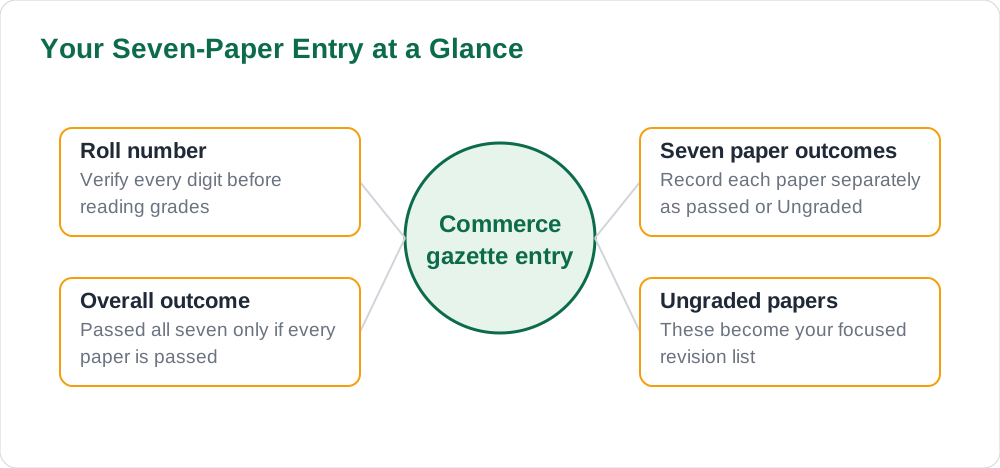
A seven-paper entry needs a method, because seven outcomes are easy to blur together if read quickly. Write the seven papers down as a list, in the order they appear in your entry, and record the outcome for each one separately before forming any overall judgement. Mark each paper as passed or Ungraded, and note any code or symbol you do not recognise for later clarification with your teacher. This written list turns a dense gazette line into a clear revision plan: papers marked passed need only light maintenance, while papers marked Ungraded need focused re-study. If you passed all seven, the list still helps, because it shows which passed paper was weakest and therefore most worth strengthening before Part-II.
This guide does not invent specific Commerce paper names or column headings for the gazette, because those details are not in the verified snapshot. In general terms, a Commerce entry will identify you by roll number and show an outcome for each of the seven papers, followed by an overall outcome, but the exact layout should be confirmed from the official gazette itself. If a heading is unclear, ask your college office to explain it with the gazette open, rather than guessing. Guessing a column meaning can lead to studying the wrong subject, which wastes exactly the time that a focused plan should save. Your written seven-paper list, checked against the official gazette, is the safest foundation for everything that follows.
What Seven Papers Mean for Recovery
Recovery after a seven-paper result should be proportional: one Ungraded paper needs focused work on that subject, while several Ungraded papers need a broader plan with priorities. Start with the Ungraded paper that is most foundational for your Commerce studies, or the one closest to passing if your teacher can judge that from your preparation, because early progress builds confidence for the rest. Set a daily routine that gives the Ungraded subjects real time while keeping passed subjects warm with brief revision, so that recovery in one area does not cause decline in another. Commerce students often benefit from worked practice in numerical papers and structured revision in theory papers, so match your method to the paper type rather than using the same approach for all seven.
On official procedures, this guide again stays general, because no specific supplementary or rechecking dates or fees for Commerce Regular Part-I 2026 are given in the verified snapshot. Follow the board's own notice on biek.edu.pk and ask your college which notice applies to your group, and treat forwarded messages claiming dates or fees with scepticism until confirmed officially. Do not pay anyone who offers to alter a gazette entry, because board records cannot be changed through unofficial channels. Your re-study can begin immediately, and it is the most valuable preparation you can do while any official procedure is clarified. Students seeking general study techniques can explore study guides alongside subject revision.
Common Commerce Gazette Mistakes to Avoid
The most common mistake is reading the overall outcome and stopping there, without recording which papers were passed and which were Ungraded. A second mistake is comparing a seven-paper Commerce result directly with a six-paper result from another group as if the standards were identical, when Commerce students faced an extra paper. A third mistake is trusting an unofficial gazette copy or a forwarded screenshot without checking it against biek.edu.pk, because errors in unofficial copies are hard to spot once you have acted on them. A fourth mistake is sharing your roll number or full entry publicly, which exposes personal information for no benefit. Avoiding these four mistakes costs little time and prevents most gazette-related confusion.
A final mistake is emotional rather than technical: treating a seven-paper result as a single success or failure, rather than as seven separate outcomes that can be improved one by one. Commerce is a broad group, and students often have uneven profiles across its papers, with strength in some areas and weakness in others. That unevenness is normal, and it is precisely what a paper-by-paper reading reveals. Celebrate the papers you passed, name the papers you need to improve, and return to steady study with a list that is specific enough to follow. The gazette is a starting point for that work, not the end of it, and the students who use it best are those who turn its long list into a short, personal plan.
AI Help: Muse AI
Muse AI is Meta's personal AI assistant, and it can help you organise a multi-paper result. For example, you can ask it to help you turn your seven Commerce paper outcomes into a weekly revision timetable, with more time for Ungraded papers. Join Muse with invite code LTGSWD — in the Muse app, go to Settings > Redeem token and enter the code. Disclosure: LTGSWD is the author's Muse invite code. Muse AI does not give official STBB answers — always verify against your STBB book and your teacher. Always verify against your Sindh Textbook Board book and your teacher before using anything in classwork.
5 key points you must know
- Commerce Regular: 23,549 registered, 22,693 appeared, 9,332 passed all seven papers on 26 October 2026.
- Commerce students sit seven papers, so a complete pass requires clearing one more paper than six-paper groups.
- The Commerce gazette runs to 172 pages and should be searched by full roll number, not browsed.
- Record all seven paper outcomes separately before judging the overall result.
- Follow only the board's own notice on biek.edu.pk for official procedures after an Ungraded paper.
Frequently asked questions
How many papers do Commerce Regular students sit in BIEK Part-I?
Commerce Regular students sit seven papers, so passing all papers means passing all seven. This is one more paper than the six-paper groups such as Pre-Medical.
What were the verified Commerce Regular figures for 2026?
On 26 October 2026, Commerce Regular reported 23,549 registered, 22,693 appeared, and 9,332 students who passed all seven papers.
How long is the Commerce gazette?
The Commerce gazette is reported to run to 172 pages, reflecting the large appeared cohort of 22,693 students.
How do I read my seven-paper entry correctly?
Search for your full roll number in the official gazette on biek.edu.pk, verify every digit, then write down the outcome for each of the seven papers separately before judging the overall result.
What if one Commerce paper is Ungraded?
Treat that paper as a focused revision task, start re-studying it in daily sessions, and follow the board's own notice for any official procedure. Your passed papers remain passed.
Solved notes — preview free
These guides work best with the solved exercises. Preview the solved notes free on this website — 119 solved notes for Classes 6–10 in Sindhi, Urdu, English and Arabic medium. Or browse the full solved notes catalogue for your class and medium. New solved notes are added regularly — check the catalogue for coming-soon books.