BIEK Commerce and Arts Part-I Result 2026: How to Read Your Result
The Board of Intermediate Education Karachi completed its HSC Part-I Annual Examination 2026 results on Monday, 26 October 2026, when it announced the remaining groups on the instructions of Chairman Faqir Muhammad Lakho, with Controller Zarina Rashid overseeing the release. The groups announced that day were Science Pre-Medical, Science General, Commerce in both Regular and Private categories, Humanities and Arts in both Regular and Private categories, Special Candidates in Arts Regular, and Home Economics, while Pre-Engineering had already been announced on 2 October 2026. This guide focuses on the Commerce and Arts students among that release: what the board's figures show, how to read your own result paper by paper, and what the new ungraded rule means if any paper falls below 40%.
What Was Announced on 26 October 2026
The 26 October announcement completed the HSC Part-I picture for 2026, because it covered every remaining group after Pre-Engineering had already been announced on 2 October 2026. For Commerce and Arts students, the important point is that both Regular and Private categories were included, so private candidates should read this guide alongside regular students rather than assuming it covers only college students. The results were published on the board's official website, www.biek.edu.pk, and on the official BIEK Android app, and students should check their result through those official channels rather than through screenshots or unofficial result pages, which can carry errors or outdated data. Keep a saved or printed copy of your result, because every later step, from scrutiny to reappearance, will ask for exactly what it shows.
Students should also note what this announcement was not. It was the HSC Part-I result, meaning Class XI or first year, and it should not be confused with Part-II results or with any supplementary examination. The announcement itself has already been covered by this site's result post, so this guide is written as a reading and next-steps guide rather than another announcement: it helps you understand the figures, interpret your own mark sheet, and decide what to do next. If you are a Science Pre-Medical or Science General student, the same 26 October release covers you too, but the figures and subject combinations in this guide focus on Commerce and Arts, with Science General covered in a companion guide.
Commerce Regular Figures: What the Numbers Show
For Commerce Regular, the board's release gives a complete set of figures that students can use to understand their group. A total of 23,549 students registered, 22,693 appeared, and 9,332 passed all seven papers. That means a large share of Commerce Regular students did not pass all seven papers, and many of them passed some papers while leaving others open, which is a normal and manageable outcome under the board's system. The Commerce course has seven papers rather than six, so passing all seven is a bigger task than in a six-paper group, and students should judge their own result paper by paper instead of comparing themselves with students in groups that have fewer papers or different subjects.
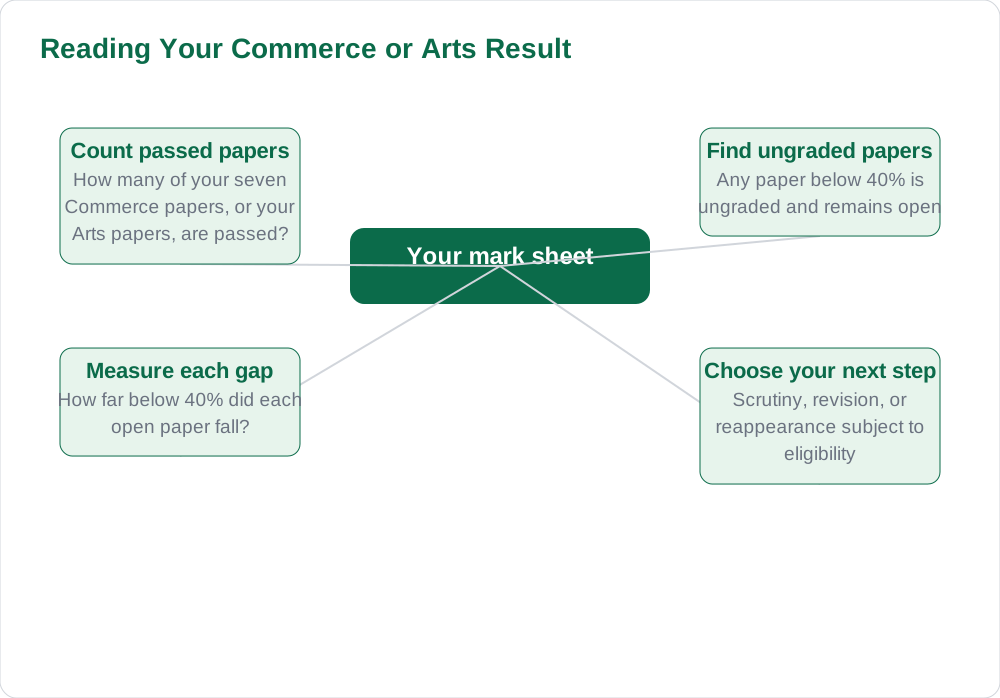
If you are a Commerce student, your first job is to read your own mark sheet against the 40% line for each of the seven papers. List the papers you passed, list the papers marked ungraded, and note how far below 40% each ungraded paper fell, because that gap decides your revision plan. A paper missed by a few marks needs targeted revision of weak chapters, while a paper with a wide gap needs a fresh study plan from the textbook. Commerce subjects such as accounting and business mathematics reward regular practice, so daily worked examples matter more than last-minute reading. For study material matched to your subjects, browse the book collection and the solved notes, and ask your college teachers which chapters carried the most marks in the papers you missed.
Arts and Humanities: What We Know From the Release
Humanities and Arts students in both Regular and Private categories were part of the 26 October announcement, and the release also gives a small, complete set of figures for Special Candidates in Arts Regular: 99 registered, 97 appeared, and 58 passed all six papers. Those figures are useful because they show the same pattern as the larger groups: a substantial share of students passed all papers, and the rest have open papers to deal with, which is a normal outcome rather than a disaster. Students in the general Arts and Humanities groups should read their own mark sheets in exactly the same way, paper by paper against the 40% line, rather than judging themselves by group totals that were not published in the release this guide is based on.
Arts students sometimes feel their result matters less than a science result, but that is a mistake, because Part-I papers feed directly into Part-II and into the final intermediate certificate. An ungraded paper left unattended in Part-I becomes a problem carried into the second year, while an ungraded paper dealt with promptly through revision and the board's formal process becomes a closed chapter. Arts subjects reward regular writing practice, so students with open papers should write answers daily, not merely read notes, and should ask teachers to mark a sample answer so that weak points are visible. Keep your result, admit card and registration details safe, and watch the board's official website for any notice about reappearance or scrutiny rather than trusting social media claims.
The Ungraded Rule: What Below 40% Means for You
The new grading system, decided by the Inter Board Committee of Chairmen together with the Sindh Universities and Boards Department, changes what a low mark means. Under this system, scoring below 40% in any paper means the paper is ungraded, which means the candidate is unsuccessful in that paper and reappears in it subject to eligibility. This replaces the older understanding in which 33% could pass a paper, and it applies across the groups announced on 26 October, including Commerce and Arts. Students should therefore read every paper on their mark sheet against the 40% line, and should not assume that a paper scored in the thirties is passed because it would have passed under an older scheme.
The practical consequence is that a student with one or two ungraded papers has a clear, limited job: revise those papers, aim comfortably above 40%, and reappear when the board's process allows. A student with several ungraded papers has a bigger job and should talk to college teachers about a realistic sequence, prioritising the papers closest to passing. In both cases, the board's official website is the only reliable source for notices about reappearance, eligibility and fees, and no reappearance date should be treated as confirmed unless it appears there. The blog carries further guides for intermediate students, including how to revise commerce and arts subjects chapter by chapter.
Next Steps: Scrutiny, Revision and Second Year Planning
If you believe a paper has been marked incorrectly, the board offers scrutiny, and the fee reported from the board's scrutiny form is Rs 1,000 per paper. No scrutiny deadline is stated in the material this guide is based on, so do not invent or trust an unofficial deadline; check the board's official website and your college notice board for the current scrutiny notice and its last date, and apply only through the official channel. Scrutiny is worth considering when your marks in a paper are far below what your class performance suggested, but it is not a substitute for revision, and students should revise the paper in parallel rather than waiting for a scrutiny outcome before opening the book.
Alongside any scrutiny decision, set up a revision routine for every open paper and protect time for second-year study as well, because Part-II work begins whether or not Part-I papers are fully cleared. Give Part-II its college hours and homework time, and protect a focused daily slot for the open Part-I papers, starting with the paper closest to passing so that an early success builds momentum. Tell your teachers which papers are open, because they can point you to the right chapters and practice material, and keep a weekly checklist of chapters revised and practice answers written. The about page explains how this site's study guides are organised for Sindh board students.
AI Help: Muse AI
Muse AI is Meta's personal AI assistant, and it can help you study by explaining a concept in simple words or by making short practice questions for revision. For this topic, you can ask Muse AI to explain how to read a BIEK mark sheet paper by paper, or to quiz you on one Commerce or Arts chapter you need to revise.
Join Muse with invite code LTGSWD — in the Muse app, go to Settings > Redeem token and enter the code.
Disclosure: LTGSWD is the author's Muse invite code.
Muse AI does not give official STBB answers — always verify against your STBB book and your teacher. In other words, always verify against your Sindh Textbook Board book before trusting any answer in an exam.
5 key points you must know
- BIEK announced HSC Part-I results for all remaining groups on 26 October 2026.
- Commerce Regular: 23,549 registered, 22,693 appeared, 9,332 passed all seven papers.
- Special Candidates (Arts Regular): 99 registered, 97 appeared, 58 passed all six papers.
- Below 40% in any paper means ungraded, and the candidate reappears in it subject to eligibility.
- BIEK scrutiny fee is Rs 1,000 per paper; check the official website for the current notice and deadline.
Frequently asked questions
Which BIEK groups were announced on 26 October 2026?
Science Pre-Medical, Science General, Commerce (Regular and Private), Humanities/Arts (Regular and Private), Special Candidates (Arts Regular), and Home Economics. Pre-Engineering had already been announced on 2 October 2026, so it was not part of the 26 October release.
How did Commerce Regular students perform in Part-I 2026?
According to the board's release, 23,549 Commerce Regular students registered, 22,693 appeared, and 9,332 passed all seven papers. Students who did not pass all seven should read their own mark sheet paper by paper to see which papers remain open.
What does ungraded mean in the BIEK Part-I result?
Under the new grading system, scoring below 40% in any paper means the paper is ungraded, so the candidate is unsuccessful in that paper and reappears in it subject to eligibility. It replaces the older understanding in which 33% could pass a paper.
What is the BIEK scrutiny fee, and is there a deadline?
The scrutiny fee reported from the board's scrutiny form is Rs 1,000 per paper. No scrutiny deadline is stated in the material this guide is based on, so check the board's official website, biek.edu.pk, and your college notice board for the current notice rather than trusting an unofficial date.
Where do I check my BIEK Part-I result officially?
On the board's official website, www.biek.edu.pk, and on the official BIEK Android app. Avoid unofficial result pages and screenshots, which can carry errors, and keep a saved or printed copy of your official result.
Solved notes — preview free
These guides work best with the solved exercises. Preview the solved notes free on this website — 119 solved notes for Classes 6–10 in Sindhi, Urdu, English and Arabic medium. Or browse the full solved notes catalogue for your class and medium. New solved notes are added regularly — check the catalogue for coming-soon books.