BIEK and Sindh Boards: The 40% Ungraded Rule Explained for Students
One rule now shapes how thousands of Sindh students read their results: under 40 percent in a paper means Ungraded, which means not passed in that paper. The rule comes from a decision involving the Inter Board Committee of Chairmen and the Sindh Universities and Boards Department, and it applies across the Sindh board results discussed in the current result season, including the BIEK HSC Part-I results of 26 October 2026 and the Shaheed Benazirabad Class IX results of 31 October 2026. For students, the change is both simple and easy to misunderstand, because Ungraded sounds like a judgement on the whole result when it actually applies paper by paper. This guide explains the rule in plain language, states clearly which exams it is reported to cover, and sets out general next steps without inventing supplementary dates, fees, or procedures. Students can find general study help through [solved notes](/solved.html), but official procedures must always come from the board's own notice. Understanding Ungraded properly is the difference between a focused recovery plan and weeks of confusion.
What Ungraded Actually Means
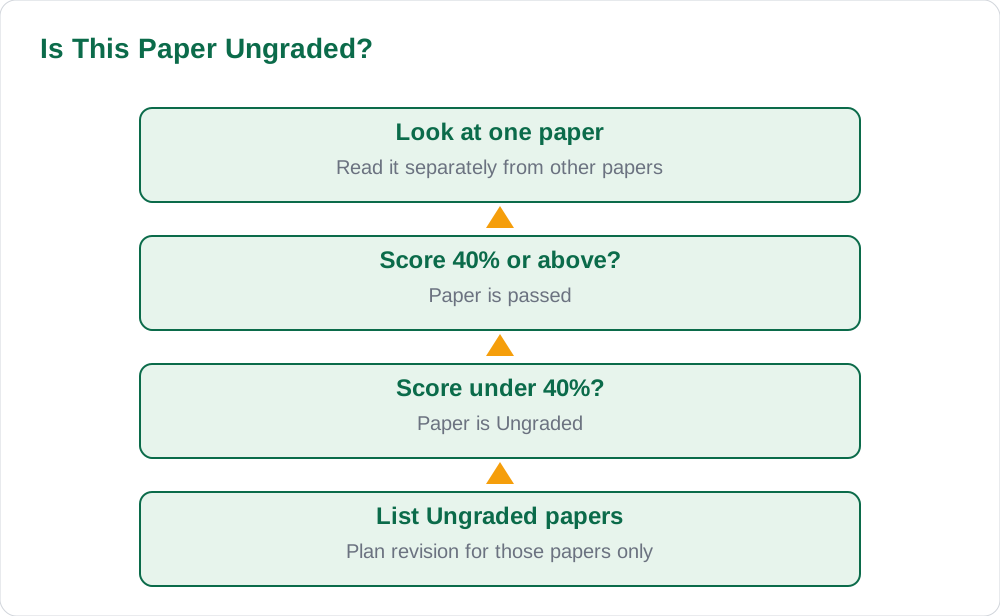
Ungraded means that in a particular paper, your score fell below 40 percent, so that paper is recorded as not passed. It does not mean that you failed every subject, it does not cancel the papers you did pass, and it does not mean that your year of study counted for nothing. Think of your result as a set of separate paper outcomes: each paper is judged on its own, and Ungraded marks only the papers below the 40 percent line. A student with five passed papers and one Ungraded paper has a very different task from a student with several Ungraded papers, even though both students might describe themselves loosely as having not passed. The paper-by-paper reading is therefore the first skill this rule requires, and it is worth practising with your own result in front of you.
The word itself can also cause unnecessary worry, because in everyday language, ungraded can sound like unmarked or ignored. In this board context, it is a defined outcome: the paper was marked, the score was below 40 percent, and the result is recorded as Ungraded rather than as a passing grade. Parents and teachers should use the word carefully and explain it the same way, because a student who hears Ungraded without explanation may assume the worst about the whole result. Calm, precise language helps students move quickly from worry to a plan, and a plan is exactly what an Ungraded paper needs: a list of topics to revisit, a study routine, and an official procedure to follow.
Which Exams Does the Rule Apply To
The verified snapshot reports the 40 percent Ungraded rule in two places: for the BIEK HSC Part-I 2026 results, where it is described as a new grading decision of the Inter Board Committee of Chairmen and the Sindh Universities and Boards Department, and for the Shaheed Benazirabad Class IX 2026 results, where it is described as a new grading decision of the Sindh Universities and Boards Department. That dual reporting suggests the rule is a Sindh-wide grading change for board examinations in this result season, rather than a quirk of a single board. This guide therefore treats it as a Sindh boards rule, while advising students to confirm how it is shown on their own board's result, because presentation can differ slightly between boards even when the underlying threshold is the same.
Students should not extend the rule beyond what is verified. This guide does not claim that the rule applies to every class, every board in Pakistan, or every type of examination, because the snapshot does not support such a broad claim. It also does not claim that older results will be reissued under the new rule, because no such statement is in the verified material. If your result comes from a different board or a different year, check that board's own notice for the grading system that applied to your examination. The safe habit is to read the rule as it appears on your own result and your own board's notice, and to ask your school if the wording on your result is unclear.
Ungraded Is Not the Same as Absent or Cancelled
Students sometimes confuse Ungraded with other result entries, so it helps to separate them clearly. Ungraded means you sat the paper and scored below 40 percent. Absent means you did not sit the paper, which is a different administrative fact with different consequences. A cancelled result, where it occurs, is a different and far more serious board action, and nothing in the verified snapshot suggests that Ungraded results are cancelled results. Mixing these terms up can lead to wrong advice, such as a student with an Ungraded paper following a procedure meant for absent students, or a student worrying about cancellation when the real task is simply to re-study one subject. Always match the word on your result to the correct meaning before you act.
The same care applies to the overall result. A result with one Ungraded paper is not the same as a result with all papers Ungraded, and neither is the same as a result that the board has withheld for some reason. If your result shows a word or code you do not recognise, do not guess its meaning from a chat group; ask your teacher or school office to explain it with the board's notice in hand. That single habit, checking the exact entry before acting, prevents most of the confusion that follows result announcements. For general revision planning while you clarify procedures, the books page can help you locate material for the subject you need to improve.
General Next Steps After an Ungraded Paper
The general next steps are deliberately general in this guide, because supplementary dates, rechecking fees, and application procedures were not given in the verified snapshot for most groups, and inventing them would mislead students. First, confirm the official position: read your board's own notice, whether that is BIEK on biek.edu.pk or Shaheed Benazirabad on bisesba.edu.pk, and ask your school which procedure applies to your class and group. Second, start re-studying the Ungraded subject now, in small daily sessions focused on the chapters and question types that caused difficulty, rather than waiting for a procedure to open before opening a book. Third, keep a written record of the notice you followed, including its date and instructions, so that you can show your school exactly what you relied on.
Fourth, keep your passed subjects warm with light revision, because a narrow focus on one paper should not cause other subjects to fade, especially if you are moving into the next class. Fifth, talk to your teacher about whether your difficulty was conceptual, practised, or exam-related, because each cause needs a different kind of practice. Conceptual gaps need re-teaching, practice gaps need worked exercises, and exam problems need timed practice. None of these steps requires a guessed date or fee, and all of them can begin today. If a future board notice announces a specific window or fee for your group, follow that notice exactly, and treat any earlier rumour as superseded by it.
- Confirm the official notice from your own board before acting.
- Start re-studying the Ungraded subject in small daily sessions.
- Keep passed subjects warm so they do not fade while you focus.
How Parents and Teachers Can Help
Parents can help most by keeping the conversation specific and calm. Instead of asking why the whole result is low, ask which papers are Ungraded and which topics inside those papers need work, because specific questions lead to specific plans. Avoid comparing the student with siblings, cousins, or classmates, because paper profiles differ and comparison rarely improves study. Help the student set up a quiet study time, check that the board notice has actually been read, and encourage the student to ask teachers for help early rather than struggling alone. A parent who treats an Ungraded paper as a normal, fixable checkpoint gives the student permission to work on it without shame.
Teachers can help by explaining the rule once, clearly, to the whole class, and then by giving individual students a short topic list for each Ungraded paper. A generic instruction to study harder is far less useful than a list of five chapters to revisit, with examples of the question types that caused trouble. Schools can also help by posting the board's notice where students and parents can read it, and by answering procedure questions from the notice rather than from memory. When parents, teachers, and students all use the same official wording for Ungraded, confusion falls and recovery starts sooner. Students planning that recovery can explore study guides for general techniques that work across subjects.
AI Help: Muse AI
Muse AI is Meta's personal AI assistant, and it can help you understand a new grading rule in plain language. For example, you can ask it to explain the difference between an Ungraded paper and a failed year, or to help you break a weak subject into small daily revision topics. Join Muse with invite code LTGSWD — in the Muse app, go to Settings > Redeem token and enter the code. Disclosure: LTGSWD is the author's Muse invite code. Muse AI does not give official STBB answers — always verify against your STBB book and your teacher. Always verify against your Sindh Textbook Board book and your teacher before using anything in classwork.
5 key points you must know
- Under 40 percent in a paper means Ungraded, which means not passed in that paper.
- Ungraded applies paper by paper, so passed papers remain passed.
- The rule is reported for BIEK Part-I and Shaheed Benazirabad Class IX under Sindh Universities and Boards and IBCC decisions.
- Ungraded is not the same as absent, and it is not a cancelled result.
- Follow only your own board's notice for procedures, and start re-studying the Ungraded subject while you wait.
Frequently asked questions
What score makes a paper Ungraded?
A score under 40 percent in that paper is shown as Ungraded, which means the paper is not passed. A score of 40 percent or above is not Ungraded under this rule.
Does one Ungraded paper mean I failed the whole year?
No. Ungraded applies to the individual paper below 40 percent. Your passed papers remain passed, and your task is to focus on clearing the Ungraded paper or papers.
Which boards does the 40 percent rule cover?
The verified snapshot reports it for BIEK HSC Part-I 2026 and for Shaheed Benazirabad Class IX 2026, under decisions involving the Sindh Universities and Boards Department and, for BIEK, the Inter Board Committee of Chairmen. Confirm how it appears on your own board's result.
What are the supplementary dates and fees for an Ungraded paper?
This guide does not state them, because no general supplementary dates or fees for Ungraded papers were given in the verified snapshot. Follow your own board's notice and ask your school which procedure applies to your class and group.
What should I study first after an Ungraded paper?
Start with the exact chapters and question types that caused difficulty in that paper, in small daily sessions, and ask your teacher for a short topic list. Keep passed subjects warm with light revision at the same time.
Solved notes — preview free
These guides work best with the solved exercises. Preview the solved notes free on this website — 119 solved notes for Classes 6–10 in Sindhi, Urdu, English and Arabic medium. Or browse the full solved notes catalogue for your class and medium. New solved notes are added regularly — check the catalogue for coming-soon books.