Benazir Bhutto: First Woman Prime Minister of Pakistan
Benazir Bhutto made history as the first woman Prime Minister of Pakistan and the first woman to lead a Muslim-majority country in modern times. She was the daughter of Zulfikar Ali Bhutto, a former Prime Minister, and she grew up in a political family during a turbulent period of Pakistan's history. Her life combined high education, long struggle, imprisonment, exile, and leadership at the highest level. For students, her story teaches the importance of education, courage, democracy, and the role of women in public life. Her assassination in 2007 shocked the world and ended a remarkable political career.
Education in Pakistan and Abroad
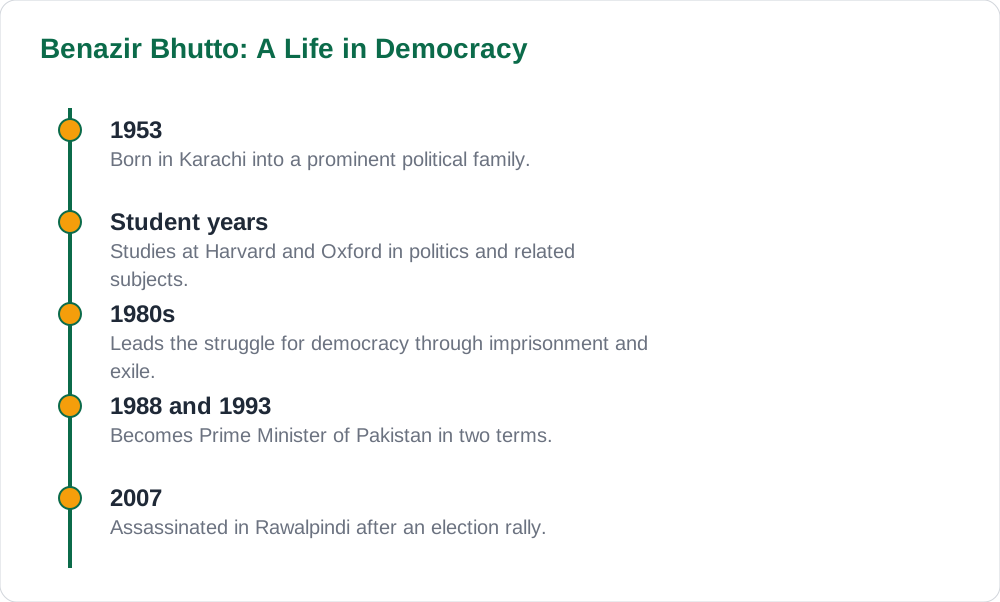
Benazir Bhutto was born in Karachi in 1953. She studied at leading institutions in Pakistan and abroad, including Harvard University in the United States and Oxford University in England, where she studied politics, philosophy, and economics. Her education gave her confidence, knowledge of world affairs, and skill in debate. Students should note that her success did not come from family name alone. She worked hard in her studies and used her education to understand democracy, law, and economics.
Her example is especially important for girls. In many families, girls' education is still treated as less important than boys' education. Benazir's life proves the opposite. An educated woman can lead a party, run a government, speak to world leaders, and inspire millions. Parents and teachers should encourage girls to study with the same seriousness as boys, and girls should aim high in every subject, including politics, science, and leadership. Find study material on the solved notes page.
Struggle for Democracy
Benazir returned to Pakistan during a military regime and joined the struggle for democracy. She faced imprisonment, house arrest, and exile, and she lost her father, Zulfikar Ali Bhutto, who was executed in 1979. These were painful years, but she did not abandon politics. She led the Pakistan Peoples Party, travelled across the country, addressed huge crowds, and kept demanding free elections and civilian rule. Her courage during this period made her a symbol of democratic resistance.
Students can learn resilience from this struggle. Life brings unfair setbacks: a family problem, a failed exam, or a lost opportunity. Resilience means continuing honest work even when conditions are unfair. It also means standing for principles peacefully. Benazir argued for democracy through elections, speeches, and organisation, not through violence. Students can practise the same peaceful courage: speaking truth politely, refusing to cheat, and standing up for classmates treated unfairly.
Prime Minister: 1988 and 1993
In 1988, Benazir Bhutto became Prime Minister after her party won elections, becoming the youngest and the first woman Prime Minister of Pakistan. She served from 1988 to 1990, and again from 1993 to 1996. Her governments worked on social issues, women's welfare, health, and education, and she tried to improve Pakistan's image abroad. Her time in office also faced criticism, political opposition, and charges of corruption, which her supporters disputed. History judges leaders with both achievements and controversies, and students should study both fairly.
Her leadership teaches an important lesson about public office. Power brings responsibility and scrutiny. A leader must answer questions, manage criticism, and keep working for the people. In school, a class leader faces similar scrutiny from classmates and teachers. The right response is not anger but honest work, transparency, and respect for rules. Benazir's career also shows that women can hold the highest office and manage complex national affairs. That fact alone changed expectations for girls across Pakistan and the Muslim world. See class books on the books page.
- Education and debate skills prepare a person for leadership.
- Democratic struggle means peaceful elections and organisation.
- Public office brings scrutiny, so leaders must work transparently.
Women's Leadership and Inspiration
Benazir Bhutto's greatest symbolic achievement was breaking a barrier. Before her, many people believed that a woman could not lead a Muslim country. After her election, that belief became much harder to hold. Girls in Pakistan, and in many other countries, could point to her and say that leadership has no gender. She spoke about women's rights, education, and health, and she encouraged women to enter politics, professions, and public service.
For students, this lesson applies in every classroom. Girls should be given chances to lead debates, manage events, and present projects. Boys should respect girl leaders and work under their leadership without embarrassment. A class that respects talent, regardless of gender, learns better and grows stronger. Benazir's life also teaches that inspiration needs action. Admiring a leader is not enough. Students must study, speak, and serve to become leaders themselves.
Assassination and Place in History
Benazir Bhutto returned to Pakistan in 2007 after years in exile to contest elections. On 27 December 2007, she was assassinated in Rawalpindi after addressing an election rally. Her death shocked Pakistan and the world, and it is remembered as a great loss for democracy. She was buried beside her father in Garhi Khuda Bakhsh in Sindh. Her party, her family, and millions of supporters mourned her as a leader who gave her life for democratic politics.
Her place in history is secure as a trailblazer. She was the first woman Prime Minister of Pakistan, a symbol of democracy, and an inspiration for women leaders worldwide. Students should remember her with fairness: celebrate her courage and achievement, and study her governments critically, as historians do for every leader. The best tribute to her is to value democracy, respect women's leadership, and take part in honest public life, starting with fairness and responsibility in school. More guides are on the blog home.
AI Help: Muse AI
Muse AI is Meta's personal AI assistant. It can explain history in simple words, summarise a lesson, and make practice questions for revision. For this article, you can ask Muse AI to summarise Benazir Bhutto's leadership in three short points for class revision. Join Muse with invite code LTGSWD — in the Muse app, go to Settings > Redeem token and enter the code. Disclosure: LTGSWD is the author's Muse invite code. Muse AI does not give official Sindh Textbook Board answers — always verify against your Sindh Textbook Board book and your teacher.
4 key points you must know
- Benazir Bhutto was Pakistan's first woman Prime Minister.
- She studied at Harvard and Oxford before leading the struggle for democracy.
- She served as Prime Minister in 1988-1990 and 1993-1996.
- Her leadership broke barriers for women in Pakistan and the Muslim world.
Frequently asked questions
Why is Benazir Bhutto historically important?
She was the first woman Prime Minister of Pakistan and the first woman to lead a Muslim-majority country in modern times.
What did she study?
She studied politics, philosophy, and economics at Harvard University and Oxford University after early education in Pakistan.
When did she serve as Prime Minister?
She served from 1988 to 1990 and again from 1993 to 1996, leading the Pakistan Peoples Party governments.
How did her life end?
She was assassinated in Rawalpindi on 27 December 2007 after addressing an election rally, during her return to democratic politics.
Solved notes — preview free
These guides work best with the solved exercises. Preview the solved notes free on this website — 119 solved notes for Classes 6–10 in Sindhi, Urdu, English and Arabic medium. Or browse the full solved notes catalogue for your class and medium. New solved notes are added regularly — check the catalogue for coming-soon books.