Ayat-ul-Kursi: Hifz and Meaning for Class 8
Ayat-ul-Kursi hifz meaning class 8 is one of the most rewarding memorisation tasks for a pupil. This great verse from Surah Al-Baqarah describes Allah as the Ever-Living, the Sustainer of all, whose knowledge covers the heavens and the earth. Many pupils know it by listening, yet they struggle to recite it fully from memory. In this guide, you will memorise Ayat-ul-Kursi in phrases, learn its meaning in clear sections, and revise it with a steady routine. Always read the verse from your own mushaf or STBB book, and check your recitation with a teacher.
What Ayat-ul-Kursi Teaches
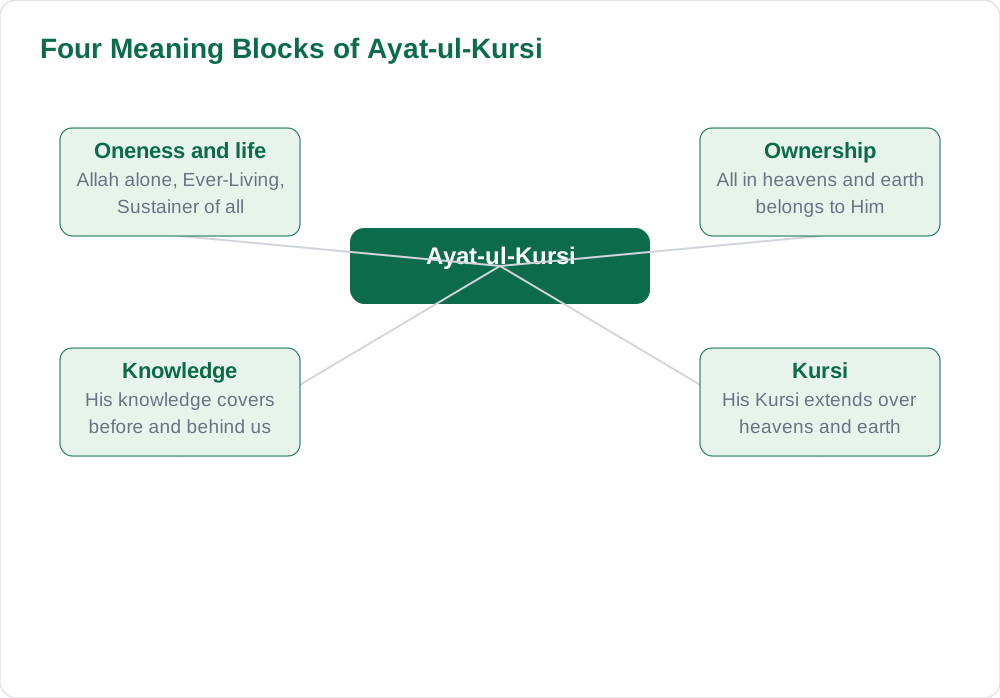
Ayat-ul-Kursi teaches that Allah alone is worthy of worship, that He is Ever-Living and sustains all creation, and that neither sleep nor slumber touches Him. It tells us that everything in the heavens and the earth belongs to Him, that no one can intercede without His permission, and that His knowledge covers all that is before us and behind us.
Before memorising, read a simple translation with your teacher and divide the verse into four meaning blocks: Allah's oneness and life, His ownership and authority, His perfect knowledge, and His vast Kursi over the heavens and earth. These blocks become your memory map. You can find more study support in the solved notes and on the books page.
Memorising in Phrases
Ayat-ul-Kursi is a single long verse, so phrase-by-phrase learning works best. Divide it into five or six short phrases at natural pauses. Read the first phrase aloud from your mushaf five to six times, then try it from memory three times. When it is smooth, add the second phrase and repeat both together.
Keep sessions to about fifteen minutes. Say each phrase slowly and clearly, and check any doubtful word in your mushaf at once. Do not rush, because a small error in a long verse can be hard to fix later. Ask a listener to follow along once a day so mistakes are caught early.
Linking Phrases to Meaning
Meaning is your best memory aid for a long verse. After learning each phrase, say its simple meaning in your own words. For example, link the opening phrases to Allah's life and care, the middle phrases to His knowledge and permission, and the closing phrases to His vast authority and protection.
Write one short meaning line for each phrase in a notebook, in Urdu or English. Read these lines before each revision. Over time, the meaning lines will guide you through the verse even when you feel unsure. This habit also helps you answer class questions with understanding rather than repeating sounds.
- Learn one simple meaning idea for every phrase before memorising it.
- Say the meaning in your own words after each recitation.
- Write short meaning lines in a notebook for quick revision.
- Re-read the translation weekly so meaning stays fresh.
Common Difficulties and Fixes
The most common difficulty with Ayat-ul-Kursi is mixing up the middle phrases, which can sound similar to a new learner. Another problem is reciting fast and skipping small words. A third problem is learning the verse once and then leaving it for weeks, which weakens memory. All three can be fixed with slow, phrase-based, repeated revision.
If two phrases feel similar, practise them side by side and note the difference in meaning. If you skip a word, slow down and repeat that phrase five times with the book open.
A Ten-Day Plan for Ayat-ul-Kursi
Use a ten-day plan for Ayat-ul-Kursi. On days one to five, learn one new phrase each day and revise earlier phrases. On days six and seven, join all phrases and recite the full verse with the book open, then try without looking.
After ten days, revise Ayat-ul-Kursi twice a week. For a shorter verse method, see the Surah Al-Humaza guide and browse the blog for more hifz plans.
- Days one to five: learn one new phrase each day and revise old phrases.
- Days six to seven: join all phrases and recite the full verse.
- Days eight to ten: revise twice daily and recite to a listener.
- After ten days, revise twice a week to keep the verse strong.
AI Help: Muse AI
Muse AI is Meta's personal AI assistant, and it can help you explain the themes of Ayat-ul-Kursi, such as Allah's power and knowledge, in simple words for Class 8. Muse AI does not give official STBB answers — always verify against your STBB book and your teacher. Always check any explanation against your Sindh Textbook Board book and ask your teacher if anything is unclear.
Join Muse with invite code LTGSWD — in the Muse app, go to Settings > Redeem token and enter the code.
Disclosure: LTGSWD is the author's Muse invite code.
5 key points you must know
- Ayat-ul-Kursi describes Allah's oneness, life, knowledge, and vast authority.
- Memorise in five or six short phrases with a join-and-repeat method.
- Learn one simple meaning idea for every phrase.
- Practise slowly, check doubtful words, and recite to a listener.
- Use a ten-day plan, then revise twice a week.
Frequently asked questions
How long does it take to memorise Ayat-ul-Kursi?
Most Class 8 pupils can memorise it in about ten days with fifteen minutes of daily practice. Learning one phrase at a time and revising earlier phrases each day makes the task manageable.
What is the best way to remember the middle phrases?
Practise similar phrases side by side and note the difference in meaning. Say the meaning in your own words after each phrase, and repeat the growing chain after every new phrase.
Should I learn the meaning of Ayat-ul-Kursi?
Yes. Meaning is the best memory aid for a long verse. Read a simple translation with your teacher, divide the verse into meaning blocks, and learn one idea for each phrase.
How do I keep Ayat-ul-Kursi fresh?
Revise twice daily for the first week after memorising it, then twice a week. Recite to a teacher or elder regularly so small mistakes are caught early.
Solved notes — preview free
These guides work best with the solved exercises. Preview the solved notes free on this website — 119 solved notes for Classes 6–10 in Sindhi, Urdu, English and Arabic medium. Or browse the full solved notes catalogue for your class and medium. New solved notes are added regularly — check the catalogue for coming-soon books.