Arabic Translation: Short Sentences Practice

Translation is where Arabic learning becomes real, because it asks a student to take words they know and turn them into meaning in another language. Short sentences are the right place to start, because they contain one idea, one verb, and a few familiar words, so the student can focus on method rather than struggling with length. Many beginners translate word by word in English order, which produces awkward or wrong sentences, but Arabic has its own word order and its own way of showing who did what. In this guide, we teach a step-by-step translation method, the most common sentence patterns, and a practice routine that turns word knowledge into confident translation.
Why Word-by-Word Translation Fails
Word-by-word translation fails because languages do not line up word for word. Arabic often puts the verb before the subject, while English and Urdu put the subject first, so a literal translation scrambles the order. Arabic also shows meaning through endings and prefixes, such as the ta in katabat showing she, which a word-by-word approach may miss entirely. A student who translates each word separately and then strings the meanings together often produces a sentence that is confusing or backwards, even when every single word was known. Good translation reads the whole sentence first and then rebuilds its meaning in natural word order.
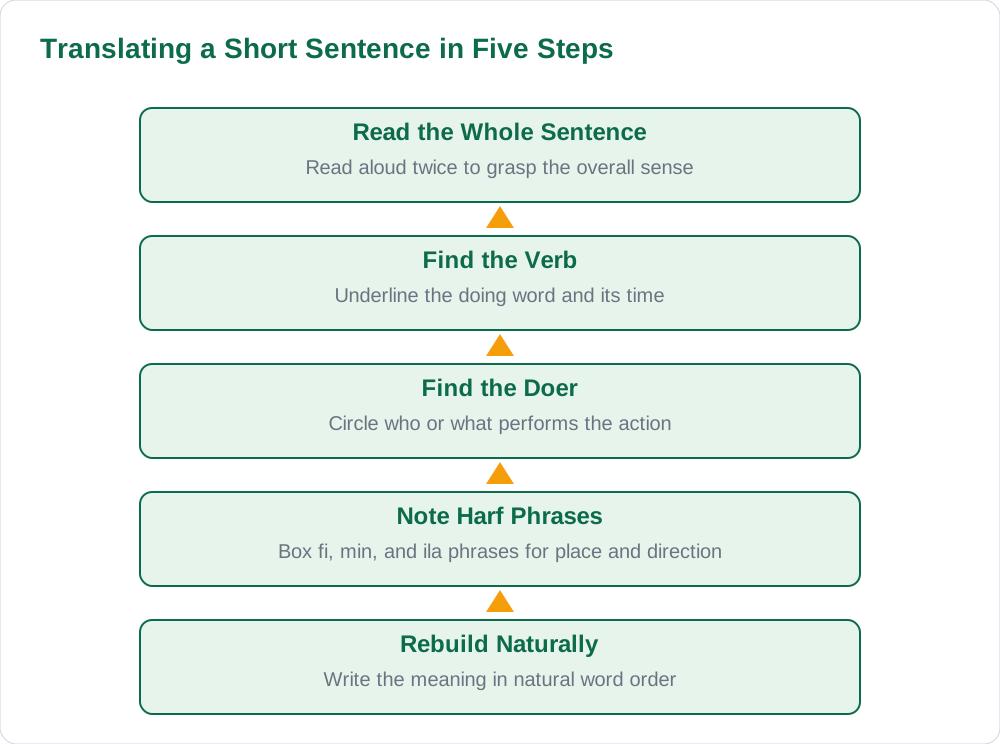
Consider the sentence Kataba al-walad al-dars, which means the boy wrote the lesson. A word-by-word reading gives wrote the boy the lesson, which is understandable but unnatural, and a careless reader might even confuse who wrote what. The correct method is to identify the verb first (kataba, wrote), then the doer (al-walad, the boy), then the object (al-dars, the lesson), and finally to rebuild in natural order. This four-step habit, read all, find verb, find doer, rebuild, is the foundation of accurate translation at every level.
Step One: Read the Whole Sentence First
Always read the whole sentence before translating any word, because the ending of a sentence can change the meaning of its beginning. A negative word, a question word, or a harf near the end may reverse or redirect the sense. Read the sentence aloud twice, once slowly to recognise the words and once smoothly to feel its overall sense. Then ask yourself a simple question: what is happening, and who is doing it? If you can answer that question in your own words, you already have the skeleton of the translation, and the details can be added afterwards.
Underlining helps at this stage. Underline the verb, circle the doer, and put a box around any harf words such as fi or min, because these markers show the structure of the sentence. This visual sorting takes only a few seconds, but it prevents the most common translation errors, such as mistaking the object for the doer or missing a negative. Students who underline before translating consistently produce more accurate work than students who start writing the translation immediately, because they have understood the sentence before trying to express it.
- Read the whole sentence aloud twice before translating
- Underline the verb, circle the doer, box the harf words
- Ask first: what is happening, and who is doing it?
Common Patterns in Short Sentences
Most beginner sentences follow a small number of patterns, and recognising the pattern makes translation much faster. The verbal pattern is verb, doer, object, as in Kataba al-walad al-dars (the boy wrote the lesson). The nominal pattern is subject plus description, as in Al-walad mujtahid (the boy is hardworking), with no verb for is. The place pattern adds a harf phrase, as in Al-walad fi al-madrasa (the boy is in the school). When you recognise which pattern a sentence follows, you know where to look for the doer, the description, or the place, and translation becomes a matter of filling the pattern rather than guessing.
Practise pattern recognition by sorting ten textbook sentences into these three patterns before translating any of them. Write V for verbal, N for nominal, and P for place sentences, and check your sorting with your teacher. After a few weeks of sorting, the patterns will jump out at you when you read, and you will translate faster and more accurately. Pattern knowledge also helps with longer sentences later, because long sentences are usually just short patterns joined together with and, or a harf phrase.
Handling New Words Without Panic
Every translation exercise contains some unfamiliar words, and the skill is to handle them calmly rather than stopping at the first unknown word. First, use the root: if you know k-t-b means writing, then a new word from that root is probably related to writing. Second, use the context: a word after fi is likely a place, and a word after kataba is likely something written. Third, use the pattern: if the sentence needs an object and one word is left over, that word is probably the object. These three clues, root, context, and pattern, often let students guess a word's sense closely enough to translate the sentence.
When guessing is not enough, mark the word, finish the rest of the sentence, and then look the word up or ask your teacher. Translating the known parts first keeps your confidence up and often makes the unknown word clearer, because its role in the sentence is now visible. Keep a translation notebook in which unknown words are written with their sentence, their guessed meaning, and their confirmed meaning. Reviewing this notebook turns each difficulty into a learnt word, and over a term the number of unknown words in each exercise falls steadily.
A Daily Translation Practice Routine
Translation improves with short, daily practice, not with rare long sessions. Translate five short sentences each day: two from your textbook, two that you write yourself in Arabic and then translate, and one that a classmate gives you. Check your translations with your teacher or a reliable answer guide, and correct mistakes immediately, because an uncorrected mistake practised repeatedly becomes a habit. Keep your corrected sentences in a notebook, and reread last week's sentences before starting new ones, so that old learning stays fresh while new learning is added.
Pair work makes translation practice more enjoyable and more accurate. One student reads an Arabic sentence aloud, the other translates it, and then they swap roles and check each other's work together. Reading aloud adds pronunciation practice to translation practice, and checking together catches errors that silent solo work misses. For more translation guides and revision material, explore Solved Notes, browse Books for your class, and visit the article index on Blog. Translation is a skill, and like every skill, it grows with daily, corrected practice.
AI Help: Muse AI
Muse AI is Meta's personal AI assistant, and it can help you practise Arabic translation by giving you short sentences to translate and checking your translations step by step. You can ask it for five sentences using a pattern you are learning, or ask it to explain why a translation needs a different word order. Muse AI does not give official STBB answers — always verify against your STBB book and your teacher. Always verify against your Sindh Textbook Board book and your teacher before using anything in classwork.
Join Muse with invite code LTGSWD — in the Muse app, go to Settings > Redeem token and enter the code. Disclosure: LTGSWD is the author's Muse invite code.
5 key points you must know
- Always read the whole sentence before translating any word.
- Identify the verb first, then the doer, then the object.
- Most beginner sentences follow verbal, nominal, or place patterns.
- Use root, context, and pattern clues for unfamiliar words.
- Five short sentences a day, corrected promptly, build translation skill.
Frequently asked questions
Why should I not translate word by word?
Languages do not line up word for word: Arabic often puts the verb before the subject, while English and Urdu put the subject first. Arabic also shows meaning through endings and prefixes that word-by-word translation may miss. Reading the whole sentence first and rebuilding its meaning in natural order gives accurate, natural translations.
What is the first step in translating an Arabic sentence?
Read the whole sentence aloud twice before translating any word, once slowly to recognise the words and once smoothly to feel its sense. Then ask what is happening and who is doing it. This gives you the skeleton of the translation, and underlining the verb and circling the doer makes the structure visible before you write.
What are the common patterns in short Arabic sentences?
Most beginner sentences follow three patterns: verbal (verb, doer, object), nominal (subject plus description, with no word for is), and place (adding a harf phrase like fi al-madrasa). Recognising the pattern tells you where to look for the doer, the description, or the place, and makes translation a matter of filling the pattern.
What should I do when I meet an unknown word in translation?
Use three clues: the root, which suggests the word family; the context, such as a word after fi likely being a place; and the pattern, which shows what role the word must fill. If guessing is not enough, mark the word, translate the rest, and then look it up or ask your teacher. Write the confirmed meaning in your notebook for review.
How much translation practice should a beginner do daily?
Five short sentences a day is an excellent goal: two from your textbook, two you write yourself, and one from a classmate. Check your work promptly and correct mistakes at once, because uncorrected mistakes become habits. Rereading last week's corrected sentences keeps old learning fresh while new learning is added.
Solved notes — preview free
These guides work best with the solved exercises. Preview the solved notes free on this website — 119 solved notes for Classes 6–10 in Sindhi, Urdu, English and Arabic medium. Or browse the full solved notes catalogue for your class and medium. New solved notes are added regularly — check the catalogue for coming-soon books.