Arabic Simple Sentences: Starting With Ana and Huwa
The simplest Arabic sentences are built from a pronoun and a description, and the two best starting points are ana, meaning I, and huwa, meaning he. Ana tilmeedh means I am a student, and huwa mudarris means he is a teacher, and both sentences follow the same easy pattern. Arabic sentences of this kind need no verb for is or am, because the pronoun and the description together already make a complete sentence. In this guide, we teach the pronouns, the sentence pattern, and the small agreements that make sentences correct, so that beginners can start speaking real Arabic sentences from their very first week.
The Pronouns Ana, Huwa, and Hiya
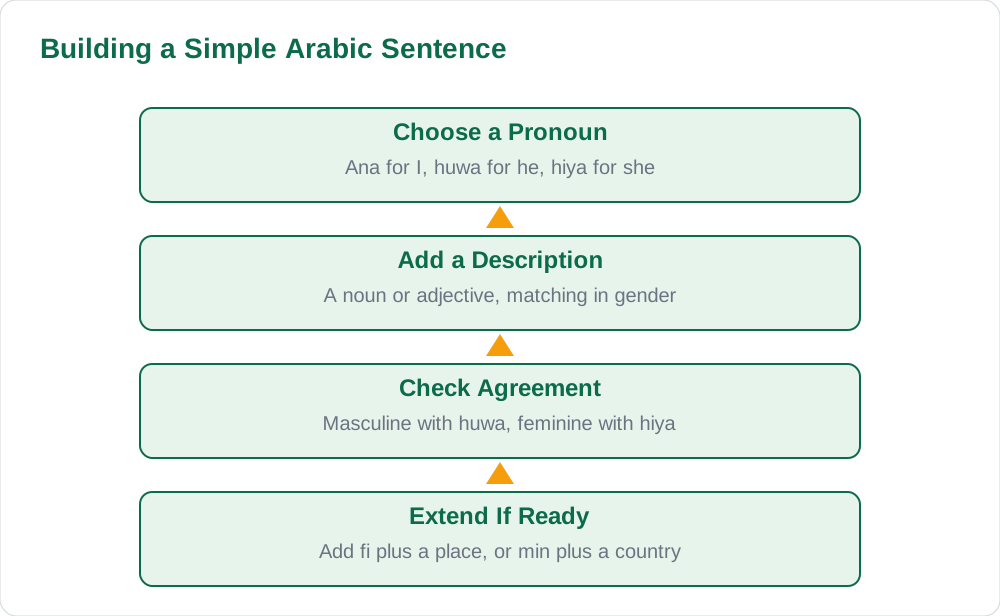
Pronouns are words that stand in place of names, and the most useful Arabic pronouns for beginners are ana (I), huwa (he), and hiya (she). Ana works for both boys and girls, which makes it the easiest pronoun to start with, while huwa is used for a boy or man and hiya for a girl or woman. Other common pronouns are anta (you, to a boy), anti (you, to a girl), nahnu (we), hum (they, masculine), and hunna (they, feminine). Learn ana, huwa, and hiya first, use them confidently, and then add the rest one at a time over the following weeks.
A helpful way to learn pronouns is to point and say them. Point to yourself and say ana, point to a boy classmate and say huwa, and point to a girl classmate and say hiya. This physical link between the word and the person makes the pronouns memorable in a way that a list alone cannot. Practise in pairs: one student points and the other names the pronoun, then swap roles. After a few rounds, the pronouns will come without thinking, and that fluency is the foundation for every sentence that follows.
The Pattern: Pronoun Plus Description
A simple Arabic sentence of this kind has two parts: a pronoun and a description, called khabar. Ana mudarris means I am a teacher, huwa tabeeb means he is a doctor, and hiya tilmeedha means she is a student. Notice that there is no separate word for is or am; the sentence is complete with just the two parts. This is a major difference from English and Urdu, where a linking verb is required, and beginners should resist the urge to add an extra word. Trust the pattern: pronoun plus description is already a full sentence in Arabic.
The description can also be an adjective rather than a noun. Ana sa'eed means I am happy, huwa taweel means he is tall, and hiya mujtahida means she is hardworking. The same pattern works in every case, which is why it is such a powerful first pattern to master. Build ten sentences about yourself and your family using this pattern, and say them aloud each day. When you can make these sentences without hesitation, you have a real speaking skill, not just a memorised list, and you can extend it endlessly with new nouns and adjectives.
- Ana tilmeedh means I am a student
- Huwa mudarris means he is a teacher
- No separate word for is or am is needed
Agreement: Matching Gender in Sentences
Arabic descriptions must agree with the pronoun in gender, and this agreement is the most important rule for simple sentences. Huwa takes the masculine form, so huwa mujtahid means he is hardworking, while hiya takes the feminine form, so hiya mujtahida means she is hardworking. The feminine form usually adds a ta marbuta ending, which is the round letter at the end of mujtahida. This rule applies to nouns as well: tilmeedh is a male student and tilmeedha is a female student, and mudarris and mudarrisa follow the same pattern for teacher.
Mistakes in agreement are the most common beginner errors, but they are also the easiest to fix once the pattern is seen. A simple check is to ask whether the person described is male or female, and then to check that the description ends the right way. Write pairs of sentences side by side, one masculine and one feminine, and read them aloud together: huwa mujtahid, hiya mujtahida. Paired practice like this trains the ear, so that a wrong ending starts to sound wrong before you even think about the rule. That ear for correctness is worth more than memorising the rule alone.
Adding Places and Qualities to Sentences
Once the two-part pattern is firm, students can extend sentences by adding a place or a quality. Ana fi al-madrasa means I am in the school, using the harf fi (in) plus the place. Huwa min Pakistan means he is from Pakistan, using min (from) plus the country. These extensions use the harf words learnt in earlier lessons, which shows how grammar topics connect: pronouns, descriptions, and harf words combine into longer, more useful sentences. Each new element should be added only after the shorter pattern is confident, because a long sentence built on a shaky pattern only practises mistakes.
Questions follow a simple pattern too. Hal anta tilmeedh means are you a student, asked to a boy, using hal to turn a statement into a question. The answer is Na'am, ana tilmeedh, yes, I am a student, or La, ana la tilmeedh, with a negative for no. Practise questions in pairs, taking turns to ask and answer about real facts: your class, your school, your favourite subject. Real answers make the practice meaningful, and meaningful practice is remembered far longer than drills with invented facts.
Speaking Practice for the First Week
The best first-week speaking goal is modest and achievable: ten sentences you can say without looking at your notes. Write them about yourself, your family, and your school, check the agreement with your teacher, and then practise them aloud morning and evening. Record yourself on a phone if possible, and listen for agreement mistakes and unclear sounds. Self-recording feels awkward at first, but it is one of the fastest ways to improve pronunciation, because you hear yourself the way others hear you.
Use your sentences in real moments too. Introduce yourself in Arabic to a classmate, describe your school in two sentences, or answer a teacher's question in Arabic instead of Urdu. Each real use builds courage alongside skill, and courage is what turns a student who knows Arabic into a student who speaks Arabic. For more sentence guides and revision material, explore Solved Notes, browse Books for your class, and visit the article index on Blog. Ten confident sentences are a better start than a hundred half-remembered ones.
AI Help: Muse AI
Muse AI is Meta's personal AI assistant, and it can help you build Arabic sentences by checking your ana and huwa sentences for agreement and suggesting new descriptions to try. You can ask it to give you ten nouns and adjectives for sentence practice, or to turn your sentences into questions for a partner drill. Muse AI does not give official STBB answers — always verify against your STBB book and your teacher. Always verify against your Sindh Textbook Board book and your teacher before using anything in classwork.
Join Muse with invite code LTGSWD — in the Muse app, go to Settings > Redeem token and enter the code. Disclosure: LTGSWD is the author's Muse invite code.
5 key points you must know
- Ana means I, huwa means he, and hiya means she.
- Pronoun plus description already makes a complete Arabic sentence.
- No separate word for is or am is needed in these sentences.
- Descriptions must agree in gender with the pronoun.
- Ten confident sentences beat a hundred half-remembered ones.
Frequently asked questions
What does ana tilmeedh mean?
Ana tilmeedh means I am a student. Ana means I, and tilmeedh means a male student, so the two words together already form a complete sentence. Arabic needs no separate word for am in this pattern, which is a major difference from English and Urdu sentence structure.
What is the difference between huwa and hiya?
Huwa means he and is used for a boy or man, while hiya means she and is used for a girl or woman. The description must agree with the pronoun, so huwa takes the masculine form and hiya takes the feminine form. For example, huwa mujtahid means he is hardworking, and hiya mujtahida means she is hardworking.
Why is there no word for is in Arabic sentences?
In a simple Arabic sentence made of a pronoun and a description, the two parts together already express the meaning completely. Ana mudarris means I am a teacher without any linking verb. Adding an extra word for is would be incorrect, so beginners should trust the two-part pattern as a complete sentence.
How do I ask a question in Arabic?
Add hal at the beginning to turn a statement into a yes-or-no question. Hal anta tilmeedh means are you a student, asked to a boy. The answer is Na'am, ana tilmeedh for yes, or a negative sentence for no. Practising questions in pairs, with real answers, makes the pattern natural quickly.
How can I practise simple Arabic sentences daily?
Write ten sentences about yourself, your family, and your school, check them with your teacher, and practise them aloud morning and evening. Use them in real moments, such as introducing yourself to a classmate in Arabic. Recording yourself and listening back also helps you catch agreement mistakes and unclear sounds early.
Solved notes — preview free
These guides work best with the solved exercises. Preview the solved notes free on this website — 119 solved notes for Classes 6–10 in Sindhi, Urdu, English and Arabic medium. Or browse the full solved notes catalogue for your class and medium. New solved notes are added regularly — check the catalogue for coming-soon books.