Arabic Sarf: Basic Verb Patterns

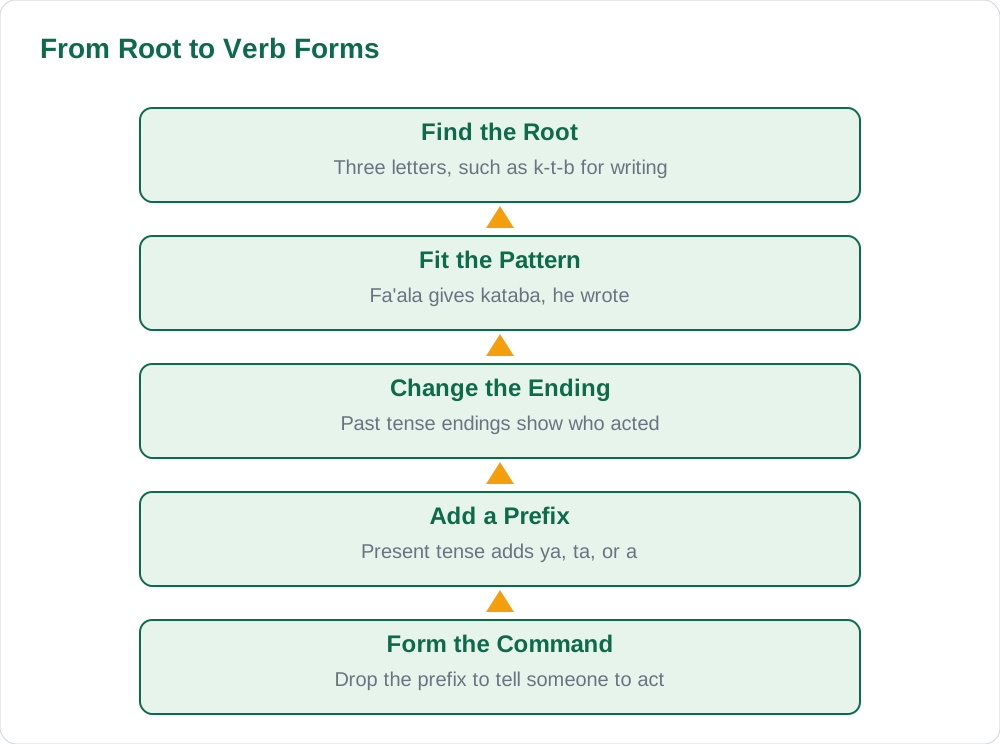
Sarf is the Arabic science of word formation, and it explains how a three-letter root grows into a family of related words. Most Arabic verbs are built from three root letters, and by fitting those letters into patterns, the language creates past, present, and command forms, as well as nouns like the doer and the place of action. The most famous pattern is fa'ala, which is the model verb students meet first: fa stands for the first root letter, ain for the second, and lam for the third. In this guide, we explain roots, the fa'ala pattern, and the basic past, present, and command forms, using the well-known root k-t-b, writing, as our running example.
Roots: Three Letters, One Core Idea
A root is a set of usually three letters that carries a core meaning, and most Arabic words are built by placing those letters into patterns. The root k-t-b carries the idea of writing, and it appears in kataba (he wrote), kitab (book), katib (writer), and maktaba (library). The root d-r-s carries the idea of studying, giving darasa (he studied), dars (lesson), and madrasa (school). When students learn to spot the root inside a new word, vocabulary stops feeling random, because each new word joins a family whose meaning is already partly known. This is the great advantage of Arabic: its words are connected by design.
To find a root, strip away the extra letters of a pattern and look for the three letters that remain in order. In yaktubu (he writes), the ya at the beginning and the u at the end are pattern letters, leaving k-t-b. In maktaba, the ma at the beginning and the ta at the end are pattern letters, again leaving k-t-b. Practise root-spotting on ten words from your textbook, and check your answers with your teacher, because a few words have tricky spellings. Once root-spotting becomes a habit, every new word teaches you about its whole family at the same time.
The Model Verb Fa'ala
Fa'ala is not a real verb but a model, a template that shows where the root letters go. The fa takes the place of the first root letter, the ain takes the second, and the lam takes the third. For the root k-t-b, fa'ala becomes kataba, because k replaces fa, t replaces ain, and b replaces lam. For the root d-r-s, fa'ala becomes darasa. This model lets teachers explain a whole pattern once, using fa'ala, and then students can apply it to any root they know. It is a clever teaching device, and understanding it is the key that unlocks sarf for beginners.
Students sometimes ask why the model uses fa, ain, and lam, and the answer is simply that fa'ala itself is a real verb meaning he did, built from the root f-a-l. Teachers chose it as the model because its letters are easy to tell apart. Do not confuse the model letters with the root letters: in kataba, the real letters are k, t, and b, while fa, ain, and lam are only placeholders that show the pattern. Keeping this distinction clear prevents the most common confusion in early sarf lessons.
- Fa stands for the first root letter, ain for the second, lam for the third
- K-t-b in the fa'ala pattern gives kataba, he wrote
- D-r-s in the fa'ala pattern gives darasa, he studied
Past Tense: Changing the Ending for the Person
The past tense in Arabic changes its ending to show who did the action. Kataba means he wrote, katabat means she wrote, katabta means you wrote (to a boy), katabti means you wrote (to a girl), and katabtu means I wrote. The beginning of the verb stays the same, katab, and only the ending changes, which makes the past tense one of the easiest patterns to learn. Practise by taking one verb, such as darasa, and reciting the whole set aloud: darasa, darasat, darasta, darasti, darastu. Reciting the set as a song or rhythm helps the endings stick in memory.
Plural forms follow the same idea with different endings. Katabu means they wrote (masculine plural), katabna means they wrote (feminine plural), and katabna also means we wrote, with context showing which is meant. Beginners do not need to master every plural form at once; learning the singular set firmly first, and then adding the common plurals, is the sensible order. A good exercise is to write five past-tense sentences about yesterday, using different persons: what I did, what he did, what she did. Real sentences about your own day make the endings meaningful rather than abstract.
Present Tense and Command Forms
The present tense adds a prefix letter to the verb and changes the vowel pattern. Yaktubu means he writes or is writing, taktubu means she writes, and aktubu means I write. The prefixes are ya for he, ta for she and you, and a for I, and the verb stem changes from katab to ktub in the middle. This stem change surprises beginners, but it is regular: the present tense of fa'ala verbs follows the same shape, so learning yaktubu teaches you the shape for yadrusu (he studies) and yafhamu (he understands) as well. Practise present-tense forms by describing what you are doing now, in Arabic, one sentence at a time.
The command form tells someone to do an action, and it is built from the present tense by dropping the prefix and adjusting the start. Uktub means write, said to a boy, uktubi means write, said to a girl, and uktubuu means write, said to a group. Commands are common in classrooms, where teachers say iftah (open), iqra (read), and uktub (write). Learning commands as whole words first, and then seeing how they relate to the present tense, is easier than trying to build them from rules before you have examples. Collect ten classroom commands, learn their meanings, and you will understand much more of your teacher's Arabic instructions.
A Beginner's Sarf Practice Routine
Sarf rewards small, regular practice more than occasional cramming, because patterns need time to settle. Each week, choose one root and work through its family: the past form, the present form, the command, and one or two related nouns, such as the book and the writer from k-t-b. Write the family on one page of your notebook, say each form aloud, and make one sentence with each form. By the end of a term, you will have studied ten or more roots deeply, and that deep knowledge is worth far more than a shallow acquaintance with fifty roots.
Use your textbook as the source of roots, and always check your forms with your teacher, because sarf has exceptions that beginners cannot guess. When you meet an irregular verb, note it separately rather than forcing it into the regular pattern. For more grammar guides and revision material, explore Solved Notes, browse Books for your class, and visit the article index on Blog. Sarf may look technical at first, but it is really a map of how Arabic words grow, and learning to read that map makes the whole language clearer.
AI Help: Muse AI
Muse AI is Meta's personal AI assistant, and it can help you learn Arabic sarf by taking a root you give it and showing its past, present, and command forms step by step. You can ask it to drill the kataba pattern with different persons, or to quiz you on finding the root inside new words. Muse AI does not give official STBB answers — always verify against your STBB book and your teacher. Always verify against your Sindh Textbook Board book and your teacher before using anything in classwork.
Join Muse with invite code LTGSWD — in the Muse app, go to Settings > Redeem token and enter the code. Disclosure: LTGSWD is the author's Muse invite code.
5 key points you must know
- Sarf is the science of how Arabic words are formed from roots.
- Most roots have three letters carrying one core idea.
- Fa'ala is the model pattern: fa, ain, and lam stand for the root letters.
- Past tense endings show who did the action.
- Present tense adds a prefix, and commands are built from the present form.
Frequently asked questions
What is sarf in Arabic?
Sarf is the science of word formation in Arabic. It explains how three-letter roots are fitted into patterns to create verbs, nouns, and other words. For example, the root k-t-b gives kataba (he wrote), kitab (book), and maktaba (library), all sharing the core idea of writing.
What does fa'ala mean in sarf?
Fa'ala is a model verb, not a real verb, used to show patterns. Its letters fa, ain, and lam stand for the first, second, and third root letters. For the root k-t-b, fa'ala becomes kataba, and for d-r-s it becomes darasa. The model lets teachers explain one pattern that students can apply to any root.
How does the Arabic past tense show who acted?
The past tense changes its ending to show the person. Kataba means he wrote, katabat means she wrote, katabta means you wrote to a boy, katabti means you wrote to a girl, and katabtu means I wrote. The stem katab stays the same, and only the ending changes, which makes the past tense easy to learn.
How is the Arabic present tense formed?
The present tense adds a prefix letter and changes the vowel pattern of the stem. Yaktubu means he writes, taktubu means she writes, and aktubu means I write. The prefixes ya, ta, and a show the person, and the stem changes from katab to ktub. This shape is regular for fa'ala verbs, so learning one verb teaches the pattern for others.
What is a good way to practise sarf each week?
Choose one root per week and work through its family: past, present, command, and one or two related nouns. Write the family on one notebook page, say each form aloud, and make one sentence with each form. Checking your forms with your teacher and noting irregular verbs separately keeps your practice accurate and lasting.
Solved notes — preview free
These guides work best with the solved exercises. Preview the solved notes free on this website — 119 solved notes for Classes 6–10 in Sindhi, Urdu, English and Arabic medium. Or browse the full solved notes catalogue for your class and medium. New solved notes are added regularly — check the catalogue for coming-soon books.