Common Quranic Words Every Student Should Know
The Quran uses a rich but surprisingly repeated vocabulary, and a small set of words appears again and again throughout its pages. A student who learns these common words with their meanings will find that recitation becomes more meaningful, because familiar words light up in every passage. Words like Allah, Rabb, Noor, Huda, and Rahma are not only frequent, they are also central to the message of the Quran, carrying ideas about God, guidance, light, and mercy. In this guide, we explain twenty of the most useful Quranic words in groups, with meanings and examples of how each word is used, so that students can recognise them during recitation and prayer.
Allah and Rabb: The Names Students Meet First
Allah is the proper name of God in Arabic, and it is the most frequent word in the Quran. It refers to the One God, worthy of worship, Creator and Sustainer of all things. Rabb means Lord, Sustainer, and Cherisher, the One who creates, provides for, and guides His creation step by step. In Surah Al-Fatiha, recited in every prayer, both words appear in the opening verses: praise belongs to Allah, the Rabb of all worlds. Learning these two words together gives students the key to the opening of every prayer, because they will understand whom they are praising and why.
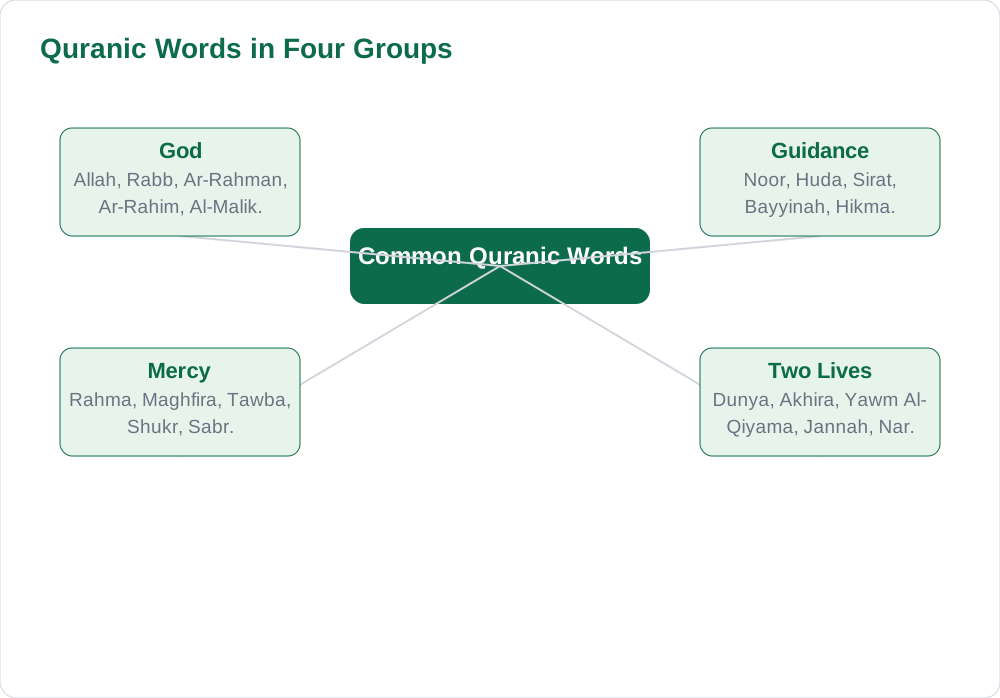
Other names and attributes appear just as often, and learning them in pairs helps. Ar-Rahman means the Most Merciful, whose mercy covers all creation, and Ar-Rahim means the Especially Merciful, whose mercy is particular to believers. Al-Malik means the King, and Al-Quddus means the Holy, free from all defect. Students who learn these names with their meanings will find that their prayers gain depth, because they will know what they are saying about Allah instead of only repeating sounds. A good habit is to learn one name each week with its meaning and one sentence explaining it.
Noor, Huda, and the Language of Guidance
Noor means light, and in the Quran it describes both physical light and the light of guidance that shows the right path. Huda means guidance, the direction that leads a person to truth and success. These two words are closely linked: guidance is described as a light that removes the darkness of ignorance and confusion. When students hear that the Quran is huda for people, they can understand that it is a guide that lights the way, just as a lamp lights a dark road. This image makes the abstract idea of guidance concrete and memorable for young learners.
Related words include Sirat, meaning path, as in Sirat Al-Mustaqeem, the straight path, asked for in every rakah of prayer. Bayyinah means a clear proof, and Hikma means wisdom, the ability to put knowledge into right action. Learning guidance words as a group, Noor, Huda, Sirat, Bayyinah, and Hikma, gives students a vocabulary for talking about the purpose of revelation. When a teacher explains a verse about guidance, students who know these words can follow the explanation instead of getting lost in unfamiliar terms.
- Noor means light, including the light of guidance
- Huda means guidance towards truth and success
- Sirat Al-Mustaqeem means the straight path
Rahma, Maghfira, and the Words of Mercy
Rahma means mercy and compassion, and it is one of the most repeated ideas in the Quran. Every Surah except one begins with Bismillah Ar-Rahman Ar-Rahim, in the name of Allah, the Most Merciful, the Especially Merciful, so students meet Rahma before almost every passage they read. Maghfira means forgiveness, the covering and pardoning of sins, and Tawba means repentance, the turning back of a person towards Allah. These three words belong together: mercy invites repentance, repentance seeks forgiveness, and forgiveness is the gift of mercy. Understanding this chain helps students grasp the hopeful message that runs through the Quran.
Other mercy words include Shukr, gratitude, which is the human response to blessings, and Sabr, patience, which is steadfastness in difficulty and obedience. A student who knows Shukr and Sabr can understand many verses about character, because the Quran often pairs blessings with gratitude and hardship with patience. Practise these words by using them in reflection: name one blessing and say Shukr for it, and name one difficulty and practise Sabr in it. Vocabulary learnt through daily life stays far longer than vocabulary learnt only from a list.
Dunya, Akhira, and Words About the Two Lives
Dunya means the worldly life, the life of this world with its work, wealth, and pleasures, while Akhira means the Hereafter, the life after death. The Quran constantly compares the two, describing Dunya as temporary and Akhira as lasting, so that believers keep their priorities in order. Yawm Al-Qiyama means the Day of Standing, the Day of Judgement, when people are raised and held accountable. Jannah means Paradise, the garden of reward, and Nar means Fire, the punishment for persistent rejection and wrongdoing. These words form the vocabulary of accountability, and students meet them in almost every Surah.
Learning these words also helps students understand their own daily choices. When a student chooses honesty over cheating, or patience over anger, they are choosing with Akhira in mind, not only with immediate gain in mind. Teachers often use Dunya and Akhira to explain why short-term pleasure is not the only measure of a good decision. A useful exercise is to read a short passage with your teacher and underline every word from this guide that you recognise, counting how many familiar words appear. Most students are surprised by how many they already know.
How to Keep Learning Quranic Vocabulary
The best method for Quranic vocabulary is to learn words from the passages you actually recite, rather than from a disconnected list. When you memorise a new Surah, ask your teacher for the meanings of its key words, write them in a vocabulary notebook, and review them before your next lesson. Five words per Surah is a realistic goal, and over a school year that adds up to well over a hundred words. Review older words weekly, because vocabulary fades without review, and a word reviewed four times over a month is usually remembered for good.
Recitation with understanding also improves pronunciation and love for the Quran, because the reader knows what they are saying. Listen to a careful reciter, follow along in your copy, and pause at familiar words to recall their meanings. Do not rush to learn rare words before the common ones are firm; the common words give the greatest reward, since they appear on every page. For more Arabic guides and revision material, explore Solved Notes, browse Books for your class, and visit the article index on Blog. A few well-known words, truly understood, open the door to the whole Quran.
AI Help: Muse AI
Muse AI is Meta's personal AI assistant, and it can help you learn common Quranic words by quizzing you on their meanings and giving you example sentences that show how each word is used. You can ask it to test you on one group at a time, such as guidance words or mercy words, until you recognise them during recitation. Muse AI does not give official STBB answers — always verify against your STBB book and your teacher. Always verify against your Sindh Textbook Board book and your teacher before using anything in classwork.
Join Muse with invite code LTGSWD — in the Muse app, go to Settings > Redeem token and enter the code. Disclosure: LTGSWD is the author's Muse invite code.
5 key points you must know
- Allah is the name of God, and Rabb means Lord and Sustainer.
- Noor means light and Huda means guidance, two linked ideas.
- Rahma, Maghfira, and Tawba form the vocabulary of mercy and repentance.
- Dunya is this worldly life and Akhira is the Hereafter.
- Learning words from passages you recite beats learning from a bare list.
Frequently asked questions
What does Rabb mean in the Quran?
Rabb means Lord, Sustainer, and Cherisher, the One who creates, provides for, and guides creation step by step. It appears in the opening of Surah Al-Fatiha as Rabb of all worlds. Learning Rabb together with Allah gives students the key to the praise they recite in every prayer.
What is the difference between Ar-Rahman and Ar-Rahim?
Ar-Rahman means the Most Merciful, whose mercy covers all creation, while Ar-Rahim means the Especially Merciful, whose mercy is particular to believers. Both come from the root for mercy, Rahma. Students meet both names at the start of almost every Surah in the Bismillah.
What do Noor and Huda mean?
Noor means light, including the light of guidance, and Huda means guidance towards truth and success. The Quran is described as Huda for people, a guide that lights the way like a lamp on a dark road. Learning these two words together makes verses about guidance much easier to understand.
What are Dunya and Akhira?
Dunya means the worldly life, with its work, wealth, and pleasures, while Akhira means the Hereafter, the life after death. The Quran describes Dunya as temporary and Akhira as lasting, so believers keep their priorities in order. This pair is central to Islamic teaching about choices and accountability.
How many Quranic words should a student learn at a time?
Five words per Surah is a realistic goal, taken from passages the student actually recites. Review older words weekly, because vocabulary fades without review. Over a school year, this method builds well over a hundred words, and the common words give the greatest reward since they appear on every page.
Solved notes — preview free
These guides work best with the solved exercises. Preview the solved notes free on this website — 119 solved notes for Classes 6–10 in Sindhi, Urdu, English and Arabic medium. Or browse the full solved notes catalogue for your class and medium. New solved notes are added regularly — check the catalogue for coming-soon books.