Arabic Numbers, Days and Months

Numbers, days, and months are among the most useful Arabic vocabulary a student can learn, because they appear in dates, timetables, prices, ages, and everyday conversation. A student who can count in Arabic, name the days of the week, and say the months can already read a calendar, give the date, and understand a large part of classroom instructions. Arabic numbers from one to ten are the foundation, and once they are firm, the teens, tens, and hundreds follow clear patterns. In this guide, we teach the numbers, the days, and the months in order, with pronunciation tips and simple sentences that put the new words to work at once.
Counting from One to Ten
The numbers from one to ten are wahid (one), ithnan (two), thalatha (three), arba'a (four), khamsa (five), sitta (six), sab'a (seven), thamaniya (eight), tis'a (nine), and ashara (ten). Learn them in order first, counting on your fingers as you say them, and then practise them out of order, so that you truly know each number rather than only the sequence. A useful drill is to count objects around you in Arabic: books on a desk, students in a row, or steps on a staircase. When the numbers are tied to real things, they stick much faster than when they are repeated from a list alone.
Pay attention to pronunciation, especially the sounds that are new to Urdu or Sindhi speakers. The th in thalatha is soft, like the th in think, and the kh in khamsa is a throaty sound like clearing the throat gently. The ain in ashara is a deep throat sound that takes practice, so listen to your teacher and imitate without embarrassment. Do not worry if these sounds feel strange at first; every learner's mouth needs time to learn new positions. Short daily repetition, five minutes of counting aloud, will make these sounds natural within a couple of weeks.
- Wahid, ithnan, thalatha, arba'a, khamsa are one to five
- Sitta, sab'a, thamaniya, tis'a, ashara are six to ten
- Count real objects aloud to fix the numbers in memory
Teens, Tens, and Hundreds by Pattern
After ten, Arabic numbers follow patterns that make counting further much easier than it first appears. Eleven is ahada ashar and twelve is ithna ashar, and the teens continue with the unit number followed by ashar. The tens are twenty ishroon, thirty thalathoon, forty arba'oon, fifty khamsoon, sixty sittoon, seventy sab'oon, eighty thamanoon, ninety tis'oon, and one hundred is mi'a. Once you know the units and the tens, you can build numbers like twenty-three by combining twenty and three, following the order your teacher shows you in class. Patterns, not memorising every number separately, are the key to counting confidently.
A common classroom use of numbers is telling age and class counts. Ana umri ithna ashar sana means my age is twelve years, using ithna ashar for twelve and sana for year. Fi safi thalathoon tilmeedh means in my class there are thirty students. Practise by making true sentences about yourself: your age, the number of students in your class, the number of books in your bag. True sentences are easier to remember than invented ones, because they connect the number to something you already know. Check your sentences with your teacher, who can correct the word order and pronunciation gently.
Days of the Week in Order
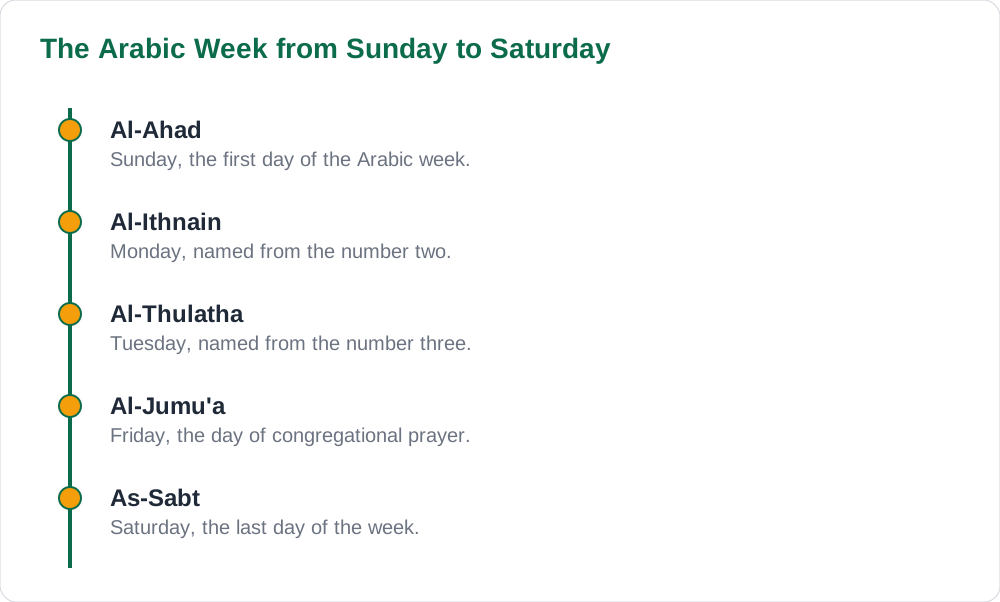
The Arabic week begins on Sunday, which is an important difference from the Monday-start week many students are used to. The days are Al-Ahad (Sunday), Al-Ithnain (Monday), Al-Thulatha (Tuesday), Al-Arbi'a (Wednesday), Al-Khamees (Thursday), Al-Jumu'a (Friday), and As-Sabt (Saturday). Notice how several day names contain the numbers: Ithnain relates to two, Thulatha to three, Arbi'a to four, and Khamees to five, which makes the middle days of the week easier to remember once the numbers are known. Friday, Al-Jumu'a, is the day of congregational prayer, and it is a special day for Muslims.
To use the days in sentences, learn the question Ma al-yawm, what day is it today, and the answer Al-yawm Al-Ahad, today is Sunday, changing the day name as needed. Practise by saying the day in Arabic every morning before school, and by writing the day and date at the top of your notebook in Arabic. A weekly routine works well: on each day, say that day's name, yesterday's name, and tomorrow's name, so that you learn the days as a moving sequence rather than a fixed list. Within two weeks, naming the days will feel automatic.
Months: Hijri and Gregorian Names
Arabic students meet two sets of month names: the Hijri months of the Islamic calendar and the Gregorian months used in everyday civil life. The Hijri months begin with Muharram, then Safar, Rabi al-Awwal, Rabi al-Thani, Jumada al-Ula, Jumada al-Akhira, Rajab, Shaban, Ramadan, Shawwal, Dhul-Qada, and Dhul-Hijja. Ramadan is the month of fasting, and Dhul-Hijja is the month of Hajj, so these two months are already familiar to most students. Learning the Hijri months in order is worthwhile, because Islamic dates, festivals, and history lessons all use them.
The Gregorian months in Arabic are Yanayir (January), Fibrayir (February), Mars (March), Abril (April), Mayu (May), Yunyu (June), Yulyu (July), Aghustus (August), Sibtambir (September), Uktubar (October), Nufambir (November), and Disambir (December). These names are borrowed and adapted, so they are easier to recognise than they first appear. Practise by writing your birthday month, the current month, and the month of Ramadan in Arabic. Combining a month with a number, such as the fifth of Ramadan, gives you a complete date, which is a genuinely useful skill for reading Islamic history and school notices.
Putting Numbers, Days, and Months Together
The real test of this vocabulary is combining it into dates and everyday sentences. Al-yawm Al-Ithnain means today is Monday, and adding a date gives a full sentence, such as today is Monday, the tenth of Ramadan. Asking Ma at-tareekh al-yawm, what is the date today, is a question students can ask every morning in class. Timetables also become good practice: say your school subjects with their days, for example Arabic on Monday and mathematics on Tuesday, using the day names you have learnt. Each combination is a small act of real communication, not just a vocabulary drill.
Keep the learning alive by using it outside the lesson. Write the date in Arabic at the top of your homework, count your pocket money or your steps in Arabic, and name the day aloud each morning. Small daily uses keep the words fresh, while a list studied once and forgotten helps nobody. For more vocabulary guides and revision material, explore Solved Notes, browse Books for your class, and visit the article index on Blog. Numbers, days, and months are the kind of vocabulary that repays every minute spent on it, because you will use it for the rest of your life.
AI Help: Muse AI
Muse AI is Meta's personal AI assistant, and it can help you learn Arabic numbers, days, and months by quizzing you in order and out of order, and by making date sentences for you to translate. You can ask it to test you on counting, to drill the days of the week, or to give you ten date sentences to practise each day. Muse AI does not give official STBB answers — always verify against your STBB book and your teacher. Always verify against your Sindh Textbook Board book and your teacher before using anything in classwork.
Join Muse with invite code LTGSWD — in the Muse app, go to Settings > Redeem token and enter the code. Disclosure: LTGSWD is the author's Muse invite code.
5 key points you must know
- One to ten are wahid, ithnan, thalatha, arba'a, khamsa, sitta, sab'a, thamaniya, tis'a, ashara.
- Tens follow patterns: ishroon is twenty, thalathoon is thirty, mi'a is one hundred.
- The Arabic week begins on Sunday, Al-Ahad, and Friday is Al-Jumu'a.
- Hijri months include Muharram, Ramadan, and Dhul-Hijja.
- Combining numbers with days and months lets students give full dates in Arabic.
Frequently asked questions
What are the Arabic numbers from one to ten?
One to ten are wahid, ithnan, thalatha, arba'a, khamsa, sitta, sab'a, thamaniya, tis'a, and ashara. Learn them in order first, then out of order, and practise by counting real objects aloud. Tying numbers to things you can see makes them stick much faster than repeating a list silently.
Which day does the Arabic week begin on?
The Arabic week begins on Sunday, Al-Ahad. The days then run Al-Ithnain (Monday), Al-Thulatha (Tuesday), Al-Arbi'a (Wednesday), Al-Khamees (Thursday), Al-Jumu'a (Friday), and As-Sabt (Saturday). Several day names come from numbers, which helps students remember the middle days of the week.
How do I ask what day it is in Arabic?
Ask Ma al-yawm, which means what day is it today, and answer with Al-yawm followed by the day name, for example Al-yawm Al-Ahad for today is Sunday. Practise this question every morning, saying the day, yesterday, and tomorrow, so the days become a moving sequence rather than a fixed list.
What are the Hijri months in order?
The Hijri months are Muharram, Safar, Rabi al-Awwal, Rabi al-Thani, Jumada al-Ula, Jumada al-Akhira, Rajab, Shaban, Ramadan, Shawwal, Dhul-Qada, and Dhul-Hijja. Ramadan is the month of fasting and Dhul-Hijja is the month of Hajj. Learning them in order helps students read Islamic dates and history lessons.
How can I practise Arabic numbers every day?
Count real things in Arabic: books on your desk, students in a row, or steps on a staircase. Write the date in Arabic on your homework, say your age in Arabic, and count your steps on the way to school. Short daily counting, even five minutes, fixes the numbers far better than one long weekly session.
Solved notes — preview free
These guides work best with the solved exercises. Preview the solved notes free on this website — 119 solved notes for Classes 6–10 in Sindhi, Urdu, English and Arabic medium. Or browse the full solved notes catalogue for your class and medium. New solved notes are added regularly — check the catalogue for coming-soon books.