Arabic: Ism, Fail and Harf — A First Introduction

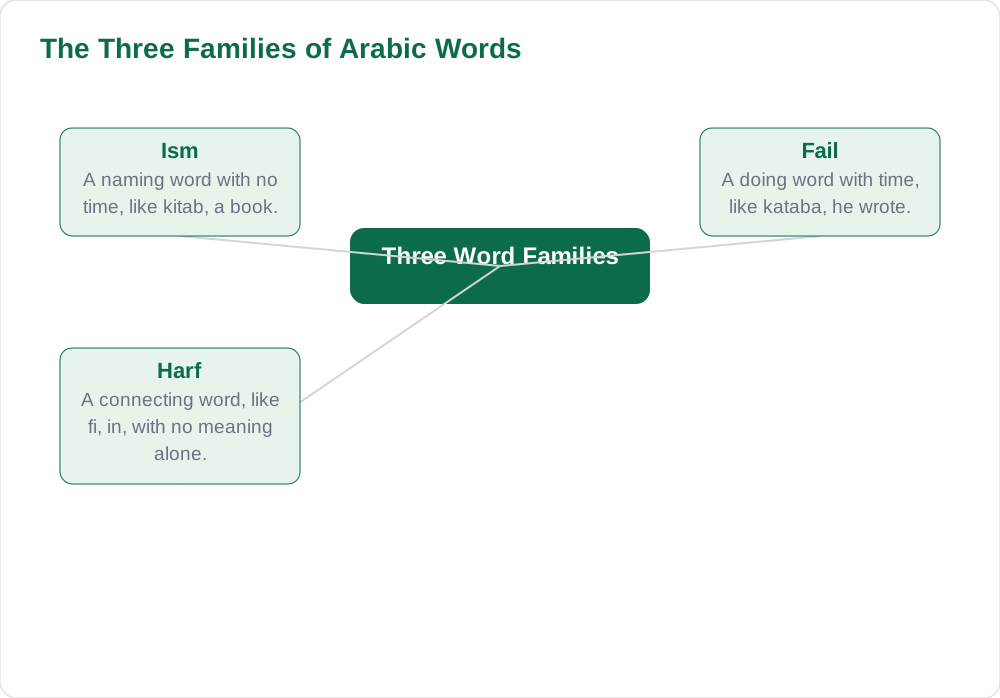
Every Arabic word belongs to one of three families: ism, fail, or harf. Ism is a noun or naming word, fail is a verb or doing word, and harf is a particle, a small word that connects other words and has no complete meaning on its own. This three-way division is the foundation of all Arabic grammar, and students who learn it early find every later grammar lesson easier, because they can sort new words into families before trying to use them. In this guide, we introduce each family with clear signs and examples, and we show a simple test that helps you decide which family any word belongs to.
Ism: The Naming Word
An ism names a person, place, thing, quality, or idea, and it does not carry the idea of time. Examples include Muhammad (a person), madrasa (a school), kitab (a book), and ilm (knowledge). A useful sign of an ism is that it can take al, the definite article, as in al-kitab, the book, or it can take tanween, the doubled vowel ending that adds an n sound. If a word can take al or tanween, it is almost certainly an ism. Another sign is that an ism can follow a harf such as fi (in) or min (from), as in fi al-madrasa, in the school.
Ism words also change for gender and number, which is a feature students meet early. Kitab is masculine and singular, kutub is its plural, books, and madrasa is feminine, marked by the ta marbuta ending. Learning an ism together with its plural is a wise habit, because Arabic plurals are often irregular and cannot always be guessed. When you meet a new ism, write it with its meaning, its plural, and one short sentence using it. This four-part note, word, meaning, plural, sentence, is one of the best vocabulary habits a beginner can build.
Fail: The Doing Word With Time
A fail is a verb, a word that shows an action together with time: past, present, or command. Kataba means he wrote, in the past, yaktubu means he writes or is writing, in the present, and uktub means write, as a command. The time element is the key difference from ism: an ism names something without time, while a fail always places its action in time. The root of most Arabic verbs is three letters, and kataba comes from the root k-t-b, which carries the idea of writing. Recognising the three-letter root helps students see the family links between words like kataba (he wrote), kitab (book), and maktaba (library).
Beginners often confuse fail and ism when a word looks similar in both families. The test is to ask whether the word shows an action in time. Kataba shows a past action, so it is a fail, while kitab names a thing, so it is an ism. Another test is to try adding al: al-kitab works, but al-kataba does not, because verbs do not take al. Practise this test on ten words from your textbook each week, sorting them into ism and fail columns, and check your answers with your teacher. Sorting practice is the fastest way to make the distinction automatic.
- Fail always carries time: past, present, or command
- Kataba means he wrote; yaktubu means he writes; uktub means write
- Verbs do not take al, while nouns often do
Harf: The Small Connecting Word
A harf is a particle, a small word that has no complete meaning on its own but gives meaning when it connects other words. Examples include fi (in), min (from), ila (to), ala (on), and an (that). On its own, fi means little, but fi al-bayt, in the house, is a complete and useful phrase. Harf words are usually short, often one or two letters, and they do not change for gender or number the way ism and fail do. They also do not take al or tanween, and they do not show time, which helps students tell them apart from the other two families.
Although harf words are small, they change the meaning of a sentence greatly. Kataba fi al-daftar means he wrote in the notebook, while kataba ala al-daftar means he wrote on the notebook, and the only difference is the harf. This is why teachers insist that students learn harf words with a full phrase, never alone. When you learn fi, learn fi al-madrasa, in the school; when you learn min, learn min al-bayt, from the house. A harf learnt inside a phrase is a harf you will use correctly, while a harf learnt alone is easily forgotten or misused.
A Simple Test for Sorting Any Word
When you meet a new word and are unsure of its family, apply three quick tests in order. First, ask whether it shows an action in time; if yes, it is a fail. Second, try adding al; if al fits naturally, it is an ism. Third, check whether the word only makes sense when joined to another word; if yes, it is probably a harf. This test does not solve every difficult case, and some words need a teacher's help, but it correctly sorts the great majority of beginner words. Keep a sorting notebook with three columns, ism, fail, and harf, and add five new words to it after each lesson.
Sorting practice also improves reading, because a reader who knows the families can predict what comes next. After a harf like fi, an ism usually follows, and after an ism that is the subject, a fail often follows. These expectations make sentences feel less like random strings of words and more like patterns. Students who practise sorting for a few minutes each week usually report that their textbook sentences suddenly look clearer, as if the words have fallen into groups. That clarity is the real reward of learning ism, fail, and harf early.
Common Mistakes and How to Avoid Them
One common mistake is to call every word that ends in a vowel an ism, but verbs also end in vowels, so endings alone do not decide the family. Another mistake is to treat harf words as unimportant because they are small, and then to mistranslate sentences because a harf was ignored. A third mistake is to memorise grammar terms without examples, which leaves students able to recite definitions but unable to sort real words. The cure for all three mistakes is the same: always learn a grammar point with five real examples from your textbook, and always test yourself by sorting new words.
Build a steady routine around this topic. Each week, choose one ism, one fail, and one harf from your lesson, write each with its meaning and a sentence, and ask your teacher to check your sorting. Over a term, this routine builds a personal grammar collection of dozens of words that you truly understand. For more grammar guides and revision material, explore Solved Notes, browse Books for your class, and visit the article index on Blog. Grammar learnt word by word, week by week, is grammar that lasts.
AI Help: Muse AI
Muse AI is Meta's personal AI assistant, and it can help you learn ism, fail, and harf by sorting words with you and explaining why each word belongs to its family. You can give it ten words from your lesson and ask it to sort them, or ask it for five new examples of each family to practise on. Muse AI does not give official STBB answers — always verify against your STBB book and your teacher. Always verify against your Sindh Textbook Board book and your teacher before using anything in classwork.
Join Muse with invite code LTGSWD — in the Muse app, go to Settings > Redeem token and enter the code. Disclosure: LTGSWD is the author's Muse invite code.
5 key points you must know
- Every Arabic word is an ism, a fail, or a harf.
- Ism names a person, place, thing, or idea, with no time element.
- Fail shows an action in past, present, or command time.
- Harf connects words and has no complete meaning on its own.
- The sorting test is: time means fail, al fits means ism, needs a partner means harf.
Frequently asked questions
What is an ism in Arabic grammar?
An ism is a naming word for a person, place, thing, quality, or idea, and it carries no idea of time. Examples are kitab (book), madrasa (school), and ilm (knowledge). Signs of an ism are that it can take al, the definite article, or tanween, and it can follow a harf like fi.
What is a fail in Arabic grammar?
A fail is a verb, a word that shows an action together with time. Kataba means he wrote in the past, yaktubu means he writes in the present, and uktub means write as a command. The time element is the key sign of a fail, and verbs do not take al the way nouns do.
What is a harf in Arabic grammar?
A harf is a small particle that connects words and has no complete meaning on its own. Examples are fi (in), min (from), and ila (to). A harf only gains full meaning inside a phrase, such as fi al-bayt, in the house, so students should always learn harf words with a full example phrase.
How can I tell whether a word is an ism or a fail?
Ask whether the word shows an action in time: if yes, it is a fail. Then try adding al: if al fits naturally, it is an ism. Kataba shows a past action, so it is a fail, while kitab names a thing and takes al as al-kitab, so it is an ism. Practising this test on textbook words makes the distinction automatic.
Why do Arabic verbs have three-letter roots?
Most Arabic verbs and many nouns are built from a three-letter root that carries a core idea. The root k-t-b carries the idea of writing, giving kataba (he wrote), kitab (book), and maktaba (library). Recognising roots helps students see word families, guess meanings more accurately, and remember vocabulary in connected groups rather than as isolated words.
Solved notes — preview free
These guides work best with the solved exercises. Preview the solved notes free on this website — 119 solved notes for Classes 6–10 in Sindhi, Urdu, English and Arabic medium. Or browse the full solved notes catalogue for your class and medium. New solved notes are added regularly — check the catalogue for coming-soon books.