Arabic Greetings and Daily Phrases
Greetings are the friendliest way to begin learning spoken Arabic, because they are short, useful, and used every single day. A student who can greet, thank, apologise, and ask politely in Arabic has already taken a real step into the language, and has also learnt something about Arab manners and Islamic etiquette. The most important greeting is Assalamu Alaikum, peace be upon you, and its reply is Wa Alaikum Assalam, and upon you be peace. In this guide, we explain the common greetings and daily phrases, how to pronounce them, when to use each one, and how to practise them until they come naturally in conversation.
Assalamu Alaikum and Its Reply
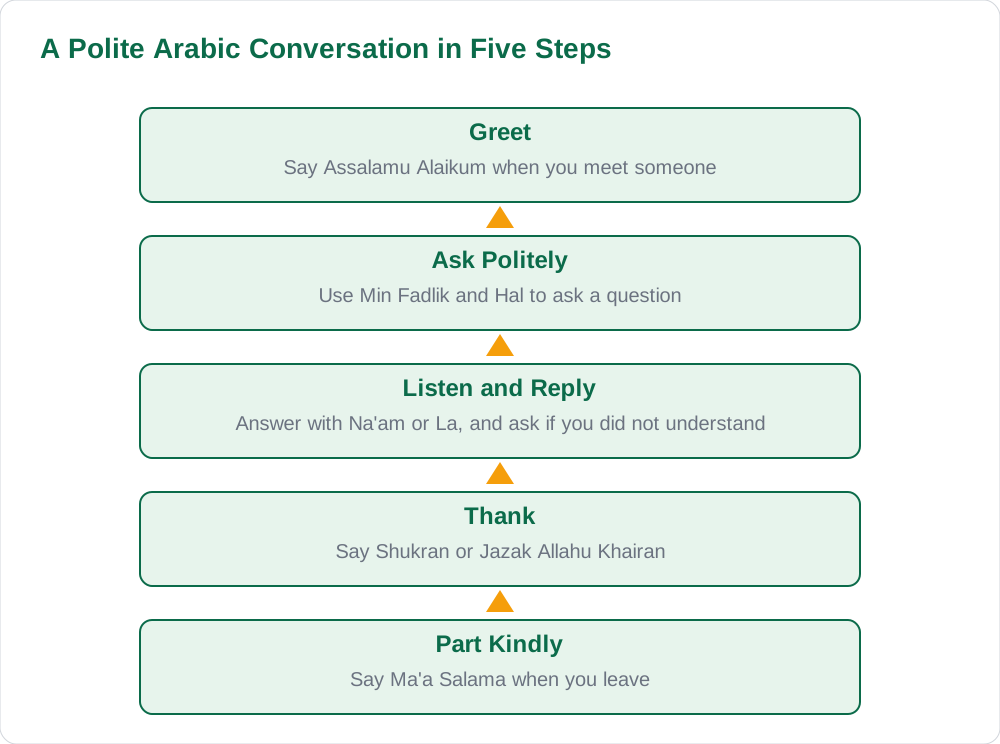
Assalamu Alaikum is the Islamic greeting, and it means peace be upon you. It is used when meeting someone, entering a room, starting a phone call, or greeting a teacher or elder. The reply, Wa Alaikum Assalam, returns the same wish of peace to the speaker, and a fuller reply adds Wa Rahmatullahi Wa Barakatuh, and the mercy of Allah and His blessings. Muslims are encouraged to greet warmly and to reply with an equal or better greeting, so learning both the greeting and the reply together is the correct approach. Practise them as a pair, not as separate words, so that the reply comes automatically when you hear the greeting.
Pronunciation matters, so break the greeting into parts and practise slowly: As-sa-la-mu A-lai-kum. Listen to your teacher's pronunciation and copy the sounds, especially the long vowel in salam and the clear k sound at the end. A common mistake is to rush the greeting into a mumbled single word, which loses both clarity and courtesy. Speak it clearly, with a smile, and look at the person you are greeting, because a greeting is a social act as much as a language exercise. When you greet your teacher or classmates in Arabic each morning, you turn a lesson into a daily habit.
Morning, Evening, and Parting Greetings
Arabic also has time-based greetings that students will hear in conversations, stories, and lessons. Sabah Al-Khair means good morning, and its reply is Sabah An-Noor, morning of light. Masa Al-Khair means good evening, with the reply Masa An-Noor. These greetings are polite and common, but Assalamu Alaikum remains the greeting Muslims use most, and it can be used at any time of day. Knowing both kinds helps students understand dialogues in their textbook, because a character might greet with Sabah Al-Khair in a morning scene and reply with Sabah An-Noor.
For parting, Ma'a Salama means with safety, or goodbye, and it is a kind wish for a safe journey. Another useful parting phrase is Ila Al-Liqa, until we meet again, which suits classmates and friends. When leaving a teacher, students often combine politeness with gratitude, saying thank you before Ma'a Salama. Learning greetings in pairs, greeting and reply, morning and evening, meeting and parting, gives students a complete small toolkit that covers almost every everyday situation they will meet in class or at home.
- Sabah Al-Khair means good morning; reply with Sabah An-Noor
- Masa Al-Khair means good evening; reply with Masa An-Noor
- Ma'a Salama means goodbye, literally with safety
Polite Phrases: Thanks, Apology, and Permission
Polite phrases make a beginner sound respectful, and they are used constantly in Arabic-speaking settings. Shukran means thank you, and Jazak Allahu Khairan, may Allah reward you with good, is a warmer Islamic way to thank someone. The reply to thanks is Afwan, which means you are welcome. When you need to apologise, say Afwan can also mean pardon, but the clearer apology is Ana Asif, I am sorry, for a boy, and Ana Asifa for a girl. These small gender differences appear throughout Arabic, and noticing them early helps students speak correctly rather than repeating one form for everyone.
Asking permission politely is another essential skill. Min Fadlik means please, said to a boy or man, and Min Fadlik is the same phrase addressed to a girl or woman, with a different ending sound. To ask a question, you can begin with Hal, which turns a statement into a yes-or-no question, as in Hal tafham, do you understand? Learning these polite frames first means that even a beginner with a small vocabulary can ask, thank, and apologise gracefully. Manners and language grow together, and teachers notice both when a student speaks politely in Arabic.
Classroom Phrases Every Student Should Know
Classroom Arabic is immediately useful, because students can use it in every lesson. Ana fahimt means I understood, and Ana lam afham means I did not understand, and both are better than silence when a lesson is unclear. A student who wants the teacher to repeat can say A'id min fadlik, please repeat. To ask the meaning of a word, say Ma ma'na hadhihi al-kalima, what is the meaning of this word? These four sentences alone can transform a student's participation, because they let the student ask for help in the language being learnt, which is exactly how language learning works best.
Other classroom phrases include Iftah al-kitab, open the book, and Ighliq al-kitab, close the book, which teachers use as instructions. Students answering a question might begin with Na'am, yes, or La, no, before giving their answer. Practise classroom phrases by role-playing with a partner: one student plays the teacher giving instructions, and the other responds and asks questions. After a few rounds, swap roles. This kind of paired speaking practice is more effective than memorising a list silently, because speaking aloud builds the mouth memory that silent study cannot give.
Practising Phrases Until They Become Natural
The secret to speaking phrases naturally is to use them in real moments, not only in study time. Greet your family with Assalamu Alaikum in the morning, thank your mother with Jazak Allahu Khairan after a meal, and say Ma'a Salama when a guest leaves. Each real use strengthens the phrase far more than ten silent repetitions from a list. Keep a small phrase diary in which you write one new phrase each day with its meaning and a sentence showing when you used it. At the end of the week, read the diary aloud and check which phrases you now use without thinking.
Pair practice also helps a great deal. Find a classmate and agree to greet each other in Arabic every day for a week, then add one new phrase each week, such as a thanks, an apology, or a classroom question. Mistakes are part of the process, and a good partner corrects gently and keeps the conversation going. For more study guides and revision material, visit Solved Notes, browse Books for your class, and explore the article index on Blog. Speaking a language is a habit, and habits are built one greeting at a time.
AI Help: Muse AI
Muse AI is Meta's personal AI assistant, and it can help you practise Arabic greetings by role-playing short conversations with you, correcting your replies, and giving you new daily phrases to try. You can ask it to play the teacher while you practise classroom questions, or to quiz you on greetings and their replies. Muse AI does not give official STBB answers — always verify against your STBB book and your teacher. Always verify against your Sindh Textbook Board book and your teacher before using anything in classwork.
Join Muse with invite code LTGSWD — in the Muse app, go to Settings > Redeem token and enter the code. Disclosure: LTGSWD is the author's Muse invite code.
5 key points you must know
- Assalamu Alaikum means peace be upon you; reply with Wa Alaikum Assalam.
- Sabah Al-Khair and Masa Al-Khair cover morning and evening greetings.
- Shukran and Jazak Allahu Khairan are two ways to say thank you.
- Classroom phrases like Ana fahimt help students ask for help in Arabic.
- Daily real use turns memorised phrases into natural speech.
Frequently asked questions
What does Assalamu Alaikum mean, and how do I reply?
Assalamu Alaikum means peace be upon you, and the reply is Wa Alaikum Assalam, and upon you be peace. A fuller reply adds Wa Rahmatullahi Wa Barakatuh, and the mercy of Allah and His blessings. Muslims reply with an equal or better greeting, so learning the pair together is the correct method.
What is the difference between Sabah Al-Khair and Assalamu Alaikum?
Sabah Al-Khair means good morning and is a time-based greeting, while Assalamu Alaikum is the Islamic greeting of peace that can be used at any time of day. Both are polite, but Assalamu Alaikum is the greeting Muslims use most. In a morning dialogue, a character might use either, and the replies are Sabah An-Noor and Wa Alaikum Assalam.
How do I say thank you and you are welcome in Arabic?
Shukran means thank you, and Jazak Allahu Khairan, may Allah reward you with good, is a warmer Islamic thanks. The reply is Afwan, which means you are welcome. Students should learn the thanks and the reply as a pair, so that they can respond politely when someone thanks them.
How do I say I did not understand in Arabic?
Ana lam afham means I did not understand, and it is one of the most useful classroom phrases a student can learn. Saying it honestly is much better than staying silent, because it lets the teacher explain again. A student can also ask A'id min fadlik, please repeat, to hear the point a second time.
What is a good way to practise Arabic phrases every day?
Use the phrases in real moments: greet your family in Arabic, thank people with Shukran, and say Ma'a Salama when someone leaves. Keep a small phrase diary with one new phrase per day and review it weekly. Pair practice with a classmate, greeting each other in Arabic daily, also turns memorised phrases into natural speech.
Solved notes — preview free
These guides work best with the solved exercises. Preview the solved notes free on this website — 119 solved notes for Classes 6–10 in Sindhi, Urdu, English and Arabic medium. Or browse the full solved notes catalogue for your class and medium. New solved notes are added regularly — check the catalogue for coming-soon books.