Arabic Dictation and Imla Practice

Imla, or dictation, is the skill of writing Arabic correctly from hearing, and it tests everything a student has learnt: letter shapes, joining, dots, harakat, and spelling rules. Many students read Arabic reasonably well but struggle with dictation, because writing requires recalling the exact form of every letter, not just recognising it. The good news is that dictation improves quickly with the right practice, since most mistakes come from a small number of causes: misplaced dots, confused similar letters, and forgotten spelling rules. In this guide, we explain the common causes of dictation mistakes and a practical routine that builds accurate Arabic writing week by week.
Why Dictation Feels Harder Than Reading
Reading is recognition, while dictation is recall, and recall is always harder. When reading, a student can use context and familiar word shapes to guess a word, but when writing from dictation, every letter, dot, and joining stroke must be produced from memory. This is why a student who reads a passage smoothly may still misspell several words when the same passage is dictated. The gap is normal and is not a sign of low ability; it simply shows that writing needs its own practice, separate from reading practice. Students who practise dictation specifically, rather than only reading more, close this gap fastest.
Dictation also tests listening, because the student must hear each sound correctly before writing it. Similar sounds, such as seen and saad, or dal and daad, are easily confused by beginners, and a listening mistake becomes a spelling mistake. This is why dictation practice should always pair listening with writing: hear the word, repeat it aloud, and then write it. Repeating aloud gives the brain a second chance to catch the sound, and it also trains the ear to distinguish similar letters. Good dictation is therefore a listening skill as much as a writing skill.
The Most Common Dictation Mistakes
The most frequent dictation mistakes involve dots. Ba, ta, and tha share one shape and differ only by dots, so a student who writes quickly may put one dot instead of two, or place dots above instead of below. Seen and sheen, and the pairs of ha and kha, cause the same problem. The cure is slow, careful writing during practice, with a pause to check dots before moving to the next word. Speed comes later, after accuracy; a student who practises fast and careless writing only practises mistakes, while a student who practises slow and correct writing gradually becomes both fast and correct.
Another common group of mistakes involves letters that sound alike but are written differently, such as the different forms of ha, the ta marbuta at the end of feminine words, and the alif with hamza in various positions. Ta marbuta, the round ending of feminine words like madrasa, is often written as a plain ha or an open ta, which is incorrect. Hamza rules, such as when hamza sits on alif, waw, or ya, confuse many students, and they need to be learnt rule by rule with examples. Keep a personal mistake notebook: each time your teacher corrects a word, copy the correct form five times and write the rule beside it.
- Dots: ba, ta, and tha differ only by dot number and position
- Similar sounds: seen and saad, dal and daad are easily confused
- Ta marbuta and hamza placement need rule-by-rule learning
A Dictation Practice Method That Works
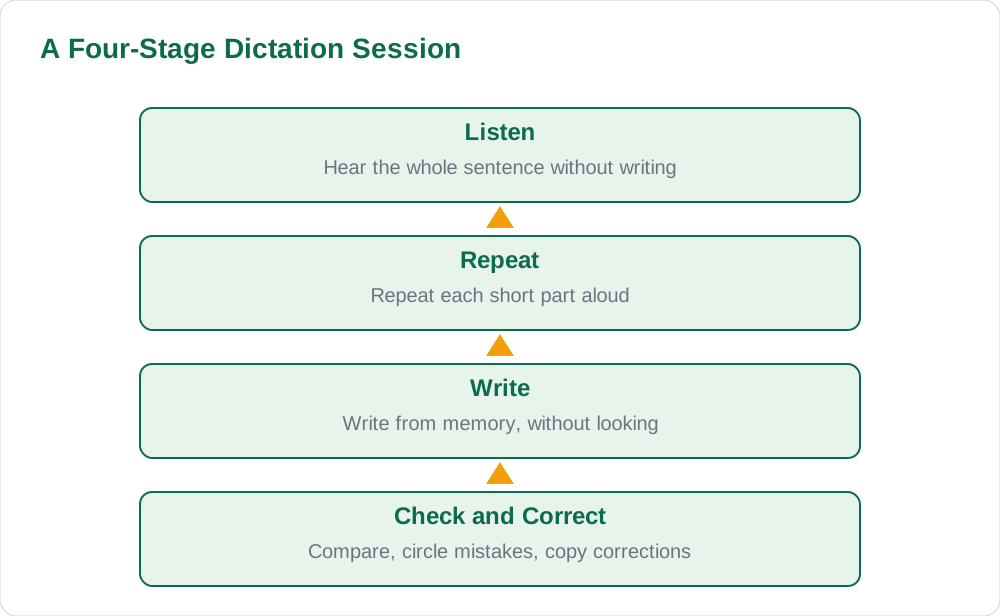
An effective dictation session has four stages: listen, repeat, write, and check. First, listen to the whole sentence without writing, to grasp its meaning. Second, listen again in short parts, repeating each part aloud. Third, write each part from memory, without looking at the book. Fourth, compare your writing with the original, circle every mistake, and copy each corrected word three times. This method takes about fifteen minutes for a short passage, and it is far more effective than writing while the teacher reads continuously, because it trains memory instead of mere copying.
Choose dictation material at the right level: passages from your current textbook chapter, not from advanced books. A passage of four to six sentences is enough for one session, and the same passage can be dictated again two days later to test whether corrections have stuck. If a word is still wrong on the second dictation, give it special attention: write it ten times, say its letters aloud as you write, and use it in a sentence of your own. Repeated, focused attention on a few stubborn words beats rushing through many new passages.
Spelling Rules Worth Learning Early
A few spelling rules remove a large number of mistakes once they are learnt. The definite article al is written with alif and lam, but when it follows a sun letter, the lam is not pronounced, although it is still written; for example, ash-shams is written with lam but pronounced without it. Moon letters, by contrast, keep the lam pronounced, as in al-qamar. Learning which letters are sun letters and which are moon letters, in groups, prevents a whole class of reading and writing errors, and teachers often test this topic directly.
Other useful rules include the spelling of long vowels, the use of alif after certain verb endings, and the difference between the feminine ending ta marbuta and the regular ta. Each rule should be learnt with five examples, not as an abstract statement, and each example should be written out by hand. A rule learnt with examples is a rule you can apply, while a rule learnt as words alone is easily forgotten under the pressure of dictation. Ask your teacher to dictate sentences that use the rule you are learning, so that the rule is practised in context immediately.
Building a Steady Imla Routine
A steady imla routine needs only fifteen minutes, three times a week, to produce visible improvement within a month. On each session, dictate a short passage, check it carefully, and record your score: the number of words correct out of the total. Watching the score rise over weeks is motivating, and it also shows which kinds of mistakes remain, so that practice can target them. Share your scores with your teacher, who can suggest the next rule or passage to practise. Progress in dictation is easy to measure, which makes it one of the most satisfying areas of Arabic study.
Family members can help with dictation even if they are not Arabic experts, by reading a passage slowly while the student writes, and then helping to compare the result with the book. Classmates can also dictate to each other in pairs, taking turns as reader and writer. The key is always the same: listen carefully, write from memory, check honestly, and correct thoroughly. For more writing guides and revision material, explore Solved Notes, browse Books for your class, and visit the article index on Blog. Accurate writing is a skill that serves every other part of Arabic study.
AI Help: Muse AI
Muse AI is Meta's personal AI assistant, and it can help you practise Arabic dictation by explaining spelling rules like sun and moon letters and by giving you short passages to write from hearing. You can ask it for sentences that use ta marbuta or hamza, or ask it to explain why a word you misspelled is written that way. Muse AI does not give official STBB answers — always verify against your STBB book and your teacher. Always verify against your Sindh Textbook Board book and your teacher before using anything in classwork.
Join Muse with invite code LTGSWD — in the Muse app, go to Settings > Redeem token and enter the code. Disclosure: LTGSWD is the author's Muse invite code.
5 key points you must know
- Dictation tests recall, while reading only tests recognition.
- Most mistakes come from dots, similar sounds, and a few spelling rules.
- The four-stage method is listen, repeat, write, and check.
- Sun and moon letters decide whether al is pronounced.
- Fifteen minutes, three times a week, shows visible improvement in a month.
Frequently asked questions
Why is Arabic dictation harder than reading?
Reading is recognition, but dictation is recall: every letter, dot, and joining stroke must be produced from memory. Reading also allows guessing from context and word shapes, while dictation does not. The gap is normal, and dictation-specific practice, rather than only more reading, is what closes it fastest.
What causes most Arabic dictation mistakes?
Most mistakes come from misplaced dots, such as confusing ba, ta, and tha, from similar sounds like seen and saad, and from spelling rules like ta marbuta and hamza placement. Slow, careful writing during practice, with a pause to check dots, prevents most dot errors. A personal mistake notebook, with each corrected word copied five times, targets the rest.
What is a good dictation practice method?
Use four stages: listen to the whole sentence without writing, repeat each short part aloud, write each part from memory without looking, and then compare with the original, circling mistakes and copying each correction three times. This method trains memory rather than mere copying, and fifteen minutes for a short passage is enough.
What are sun letters and moon letters?
Sun letters cause the lam of al to be written but not pronounced, as in ash-shams, while moon letters keep the lam pronounced, as in al-qamar. Learning which letters belong to each group prevents a whole class of reading and writing errors. Teachers often test this topic directly, so learning the groups is well worth the effort.
How often should a student practise dictation?
Fifteen minutes, three times a week, produces visible improvement within a month. Dictate a short passage of four to six sentences, check it carefully, and record your score to track progress. Repeating the same passage two days later tests whether corrections have stuck, and stubborn words deserve ten careful copies each.
Solved notes — preview free
These guides work best with the solved exercises. Preview the solved notes free on this website — 119 solved notes for Classes 6–10 in Sindhi, Urdu, English and Arabic medium. Or browse the full solved notes catalogue for your class and medium. New solved notes are added regularly — check the catalogue for coming-soon books.