Class 8 Arabic Syllabus: A Complete Overview
Class 8 Arabic is the year in which earlier basics come together into real reading, writing, and understanding. Students who have learnt the alphabet, harakat, and simple sentences in earlier classes now meet longer passages, more grammar, and wider vocabulary, and they are expected to read with understanding, answer questions, and write short pieces of their own. This overview explains what the Class 8 Arabic course generally covers, how its lessons are organised, and how students can prepare steadily through the year. It is a general study guide based on the usual shape of middle-school Arabic courses, so students should always confirm the exact lessons and chapters in their own Class 8 Arabic textbook and with their teacher.
What Class 8 Arabic Builds On
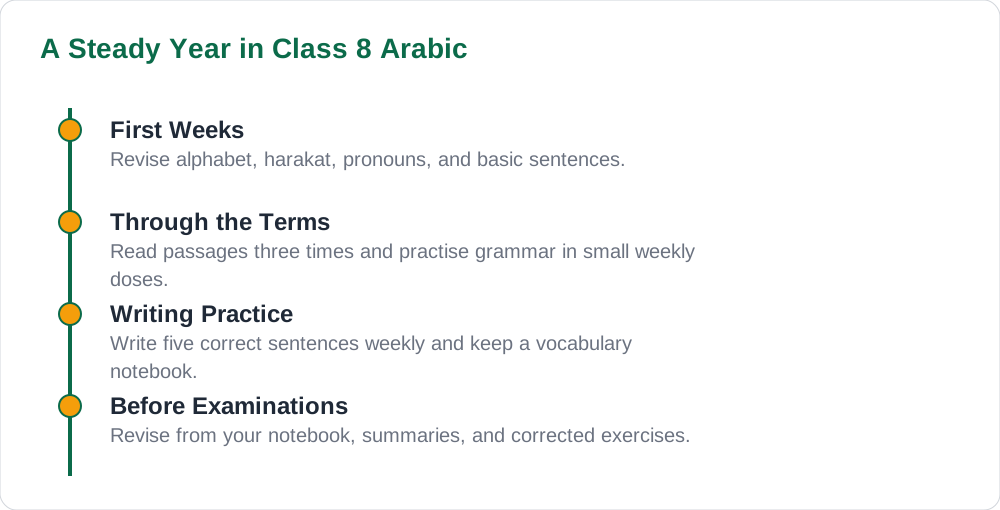
Class 8 Arabic assumes that students can already read Arabic script with harakat, recognise common words, and form simple sentences with ana, huwa, and hiya. If any of these basics are shaky, Class 8 becomes much harder, because new lessons move faster and expect independent reading. The wisest start to the year is therefore a short revision of the basics during the first two weeks: the alphabet and joining, the harakat, the pronouns, and the common classroom phrases. Students who revise these foundations find that the new material feels like an extension of what they know, rather than a sudden jump into difficulty.
Class 8 also builds on earlier vocabulary in a systematic way. Words learnt in earlier classes reappear in new passages, joined by new words from the same families, so vocabulary grows by connection rather than by unrelated lists. For example, a student who knows kitab will meet katib, maktaba, and darasa-related words in new contexts, and the root system makes these connections visible. Keeping a vocabulary notebook from earlier classes, and reviewing it regularly, is therefore not a waste of time but one of the best preparations for Class 8 success.
Reading Passages and Comprehension
Reading is the heart of Class 8 Arabic, and passages are typically longer and richer than in earlier classes. They may describe daily life, good manners, Islamic teachings, or simple stories, and they introduce new vocabulary in context rather than in isolation. The comprehension skill expected at this level is not just sounding out words, but understanding the passage well enough to answer questions about it: who did what, why it happened, and what lesson it teaches. Students should practise reading each passage three times: once for sounds, once for meaning, and once to answer questions.
A useful comprehension habit is to underline new words during the first reading, guess their meanings from context during the second, and confirm them with a dictionary or teacher during the third. Writing a one-sentence summary of each paragraph in your own words, in Urdu or simple Arabic, also proves that you have understood rather than only decoded the text. Students who summarise regularly find examination comprehension questions much easier, because they have already practised turning a passage into its main ideas many times before the examination.
- Read each passage three times: sounds, meaning, then questions
- Underline new words, guess from context, then confirm meanings
- Summarise each paragraph in one sentence of your own
Grammar Topics in Class 8
Grammar in Class 8 typically extends the three word families, ism, fail, and harf, into more detailed work. Students meet verb forms beyond the simplest past and present, learn more about pronouns and agreement, and practise using harf phrases to build longer sentences. The emphasis is on using grammar to understand passages and to write correctly, not on memorising definitions alone. A student who can sort words into ism, fail, and harf, and who can spot the verb and doer in a sentence, already has the tools for most Class 8 grammar work, and new topics extend these tools step by step.
The best grammar preparation is regular, small practice rather than cramming before examinations. Ten minutes of grammar practice three times a week, using sentences from the current lesson, keeps the rules fresh and builds accuracy gradually. Always learn a rule with examples from your own textbook, and always check your exercises with your teacher, because grammar mistakes practised repeatedly become hard to remove. A grammar notebook with one page per rule, each page carrying five examples, becomes a valuable revision resource by examination time.
Writing, Translation, and Dictation
Writing in Class 8 moves from copying and single sentences towards short paragraphs and guided composition. Students may be asked to write a few sentences about themselves, their school, or a lesson topic, using the vocabulary and grammar they have learnt. Good writing at this level is simple and correct rather than long and error-filled: short sentences with correct agreement and spelling score better than ambitious sentences full of mistakes. Practise by writing five correct sentences each week on a lesson topic, and asking your teacher to mark them, so that errors are caught early.
Translation and dictation remain important parts of the course as well. Short-sentence translation tests whether students understand structure, not just individual words, and dictation tests spelling, listening, and letter formation together. Both skills improve with the short daily routines described in study guides: five translations a day, and fifteen minutes of dictation three times a week. Students who keep these routines through the year arrive at examinations with skills that cannot be crammed in the final week, because they have been built gradually and tested repeatedly.
How to Prepare Through the Year
Steady preparation beats last-minute study in Arabic, because language skills grow with repetition over time. A realistic weekly routine is: read the current lesson aloud three times, learn five new words with sentences, do ten minutes of grammar practice, and write five sentences on the lesson topic. This routine takes under an hour spread across the week, yet it covers reading, vocabulary, grammar, and writing together. Students who follow it find that examinations feel like a review of familiar work, rather than a first encounter with forgotten lessons.
Examination preparation should start from your own notes, not from new material. Reread your vocabulary notebook, your grammar pages, and your corrected exercises, and practise past-style questions: comprehension questions on a passage, translation of short sentences, and dictation of a familiar paragraph. Confirm the exact syllabus, chapters, and paper pattern with your teacher and your own textbook, because general guides cannot replace the official course for your class. For more Arabic guides and revision material, explore Solved Notes, browse Books for your class, and visit the article index on Blog.
AI Help: Muse AI
Muse AI is Meta's personal AI assistant, and it can help you prepare for Class 8 Arabic by explaining syllabus topics in simple words, quizzing you on vocabulary, and giving you short reading and translation practice. You can ask it to summarise a grammar rule, to test you on a lesson's words, or to help you plan a weekly study routine. Muse AI does not give official STBB answers — always verify against your STBB book and your teacher. Always verify against your Sindh Textbook Board book and your teacher before using anything in classwork.
Join Muse with invite code LTGSWD — in the Muse app, go to Settings > Redeem token and enter the code. Disclosure: LTGSWD is the author's Muse invite code.
5 key points you must know
- Class 8 Arabic builds on alphabet, harakat, pronouns, and simple sentences.
- Reading passages require comprehension, not just sounding out words.
- Grammar extends ism, fail, and harf into longer, correct sentences.
- Writing favours short, correct sentences over long, error-filled ones.
- A steady weekly routine beats last-minute cramming for examinations.
Frequently asked questions
What should I revise before starting Class 8 Arabic?
Revise the alphabet and joining, the harakat, the pronouns ana, huwa, and hiya, and common classroom phrases during the first two weeks. These basics are assumed in Class 8, and shaky foundations make new lessons much harder. Students who revise them find new material feels like an extension of what they know.
How should I read a Class 8 Arabic passage?
Read each passage three times: once for sounds, once for meaning, and once to answer questions. Underline new words on the first reading, guess their meanings from context on the second, and confirm them with your teacher on the third. Writing a one-sentence summary of each paragraph also proves real understanding.
What grammar is covered in Class 8 Arabic?
Class 8 grammar typically extends ism, fail, and harf into more detailed work, including further verb forms, pronouns and agreement, and harf phrases for longer sentences. The emphasis is on using grammar to understand passages and write correctly. Ten minutes of grammar practice three times a week, using textbook sentences, keeps the rules fresh.
How can I improve my Arabic writing in Class 8?
Write five correct sentences each week on a lesson topic and ask your teacher to mark them. Simple, correct sentences score better than long, error-filled ones. Keep a vocabulary notebook and a grammar notebook, and use them as your revision sources, because writing improves through corrected practice, not through uncorrected volume.
How do I confirm the exact Class 8 Arabic syllabus?
Always confirm the exact lessons, chapters, and paper pattern in your own Class 8 Arabic textbook and with your teacher. General overviews describe the usual shape of the course, but only your textbook and teacher give the official syllabus for your class and examination. Use this guide for study method, and your textbook for exact content.
Solved notes — preview free
These guides work best with the solved exercises. Preview the solved notes free on this website — 119 solved notes for Classes 6–10 in Sindhi, Urdu, English and Arabic medium. Or browse the full solved notes catalogue for your class and medium. New solved notes are added regularly — check the catalogue for coming-soon books.