Arabic Alphabet and Harakat for Beginners

The Arabic alphabet is the doorway to reading Arabic, and it is also the doorway to reading the Quran with understanding. Arabic has 28 letters, written from right to left, and most letters change shape depending on whether they stand alone, join to the letter before them, or join to the letters on both sides. This sounds difficult at first, but the system is regular, and students who learn a small group of letters at a time usually make fast progress. Harakat are the short vowel marks placed above or below a letter, and they tell the reader which vowel sound to pronounce. In this guide, we explain the alphabet, the letter shapes, and the harakat in simple steps, with a practice method that any beginner can follow at home or in class.
The 28 Letters and the Right-to-Left Direction
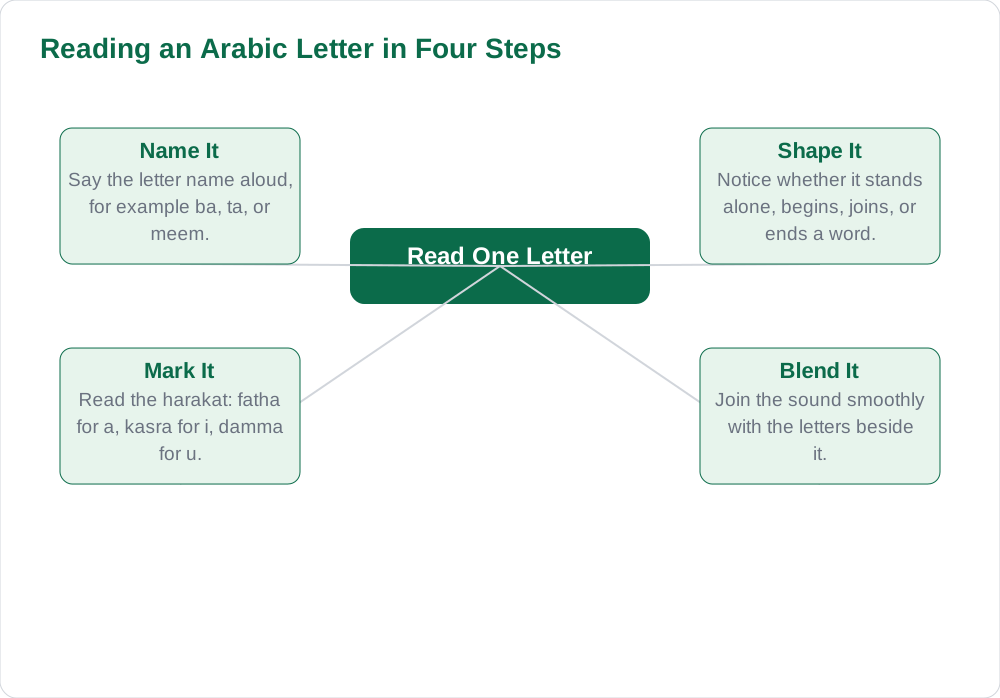
Arabic is written and read from right to left, which is the first habit a beginner must build. Start at the right side of the page and move leftwards, and practise by pointing at each letter as you read it. The 28 letters are alif, ba, ta, tha, jeem, ha, kha, dal, dhal, ra, zay, seen, sheen, saad, daad, ta, za, ain, ghain, fa, qaf, kaf, lam, meem, noon, ha, waw, and ya. Do not try to memorise all 28 in one sitting; learn them in groups of four or five, saying each name aloud and writing it several times. When you can name and write one group without hesitation, add the next group.
Many Arabic letters come in pairs that look alike but differ by dots. Ba has one dot below, ta has two dots above, and tha has three dots above, yet all three share the same basic shape. Seen and sheen are another pair, differing only by three dots, and the same pattern repeats with several other letters. This is good news for beginners, because learning one shape often means learning two or three letters at once. Pay close attention to the dots from the very first day, because a misplaced dot changes both the letter and the meaning of the word.
- Learn letters in small groups of four or five, not all 28 at once
- Read and write from right to left, pointing at each letter as you read
- Watch the dots carefully: ba, ta, and tha share one shape but differ by dots
How Letter Shapes Change When Letters Join
Most Arabic letters join to the letter that follows them, so a letter can look different at the beginning, middle, and end of a word. For example, the letter ba looks like a small boat with a dot below when it stands alone, but when it joins to the next letter it loses its tail and stretches into a connecting stroke. This is normal and regular, and once you learn the four forms of a few common letters, the rest become easy to predict. Practise by writing the same letter in all its forms on one line, and say the form aloud as you write it: isolated, initial, medial, and final.
Six letters do not join to the letter that follows them: alif, dal, dhal, ra, zay, and waw. When one of these letters appears in a word, the next letter must start afresh, which creates a small break inside the word. Beginners often mistake this break for the end of a word, so it is worth learning these six non-joining letters early. A simple memory trick is to call them the letters that refuse to hold hands with the next letter. Once you know them, you will read joined words more confidently, because you will expect the break instead of being surprised by it.
Harakat: The Short Vowels That Guide Pronunciation
Harakat are small marks that show the short vowel sound of a letter. Fatha is a small slant above the letter and gives an short a sound, as in ba. Kasra is a small slant below the letter and gives an short i sound, as in bi. Damma is a small curl above the letter and gives an short u sound, as in bu. These three marks are the foundation of Arabic reading, and a beginner who masters them can sound out most simple words. Practise by taking one letter, such as ba, and reading it with all three harakat in turn: ba, bi, bu, until the sounds come without thinking.
Two more marks complete the beginner's toolkit. Sukun is a small circle above a letter and means that the letter carries no vowel, so it joins its sound to the vowel before it. Tanween doubles the fatha, kasra, or damma and adds an n sound at the end, giving an, in, or un. Shadda, which looks like a small w shape, means the letter is doubled and pronounced with extra strength. You do not need to master all of these in the first week, but you should recognise them when you see them. Reading practice with harakat marked, as in school textbooks and beginners' Quran copies, makes all of these marks familiar step by step.
Long Vowels and the Letters Alif, Waw, and Ya
After the short vowels, the next step is the long vowels, which stretch a sound for about twice as long. Alif after a fatha stretches the a sound, waw after a damma stretches the u sound, and ya after a kasra stretches the i sound. For example, ba with fatha and alif becomes baa, a longer sound that is easy to hear when a teacher reads it aloud. The difference between short and long vowels matters for meaning, so listen carefully when your teacher reads and copy the length of each vowel. Reading aloud every day, even for ten minutes, trains your ear faster than silent reading alone.
A common beginner mistake is to rush past long vowels and pronounce them as short vowels, which makes words hard to recognise. Another mistake is to add a long vowel where none is written, which changes the word. The cure for both mistakes is slow, loud reading with a finger under each word. Read the word letter by letter first, then read it again as a whole word, and finally read the whole sentence smoothly. This three-pass method feels slow at first, but it builds accuracy, and accuracy is what turns a struggling reader into a confident one within a few weeks.
A Simple Daily Practice Plan for Beginners
A short daily routine beats a long weekly session, because Arabic reading is a skill that grows with repetition. Spend five minutes writing the letter group you are learning, five minutes reading words that use those letters, and five minutes listening to a teacher or a reliable recording and repeating after it. Keep a small notebook in which you copy five new words each day with their harakat and meanings, and review yesterday's words before adding new ones. If you miss a day, simply resume the next day without trying to double the work, because steady practice always beats hurried catch-up.
Use the resources around you to stay on track. Your class textbook and your teacher's pronunciation are your best guides, and solved notes can help you check your understanding of a lesson. For extra reading material and revision help, explore the collection on Solved Notes, browse the full book list on Books, and visit the article index on Blog for more study guides. Remember that every fluent Arabic reader once struggled with the first letters, so patience and daily practice will carry you further than any shortcut.
AI Help: Muse AI
Muse AI is Meta's personal AI assistant, and it can help you learn the Arabic alphabet by quizzing you on letter names, shapes, and harakat sounds one small group at a time. You can ask it to explain the difference between ba, ta, and tha, to give you simple reading drills, or to test you on fatha, kasra, and damma until they feel easy. Muse AI does not give official STBB answers — always verify against your STBB book and your teacher. Always verify against your Sindh Textbook Board book and your teacher before using anything in classwork.
Join Muse with invite code LTGSWD — in the Muse app, go to Settings > Redeem token and enter the code. Disclosure: LTGSWD is the author's Muse invite code.
5 key points you must know
- Arabic has 28 letters, written and read from right to left.
- Most letters change shape when they join, but six letters never join forwards.
- Fatha, kasra, and damma give the short a, i, and u sounds.
- Dots change the letter, so ba, ta, and tha must be told apart carefully.
- Fifteen minutes of daily reading, writing, and listening beats occasional long sessions.
Frequently asked questions
How many letters are in the Arabic alphabet?
The Arabic alphabet has 28 letters, from alif to ya. Beginners should learn them in small groups of four or five, saying each name aloud and writing it several times. Learning the groups in order, with daily review, makes the full alphabet manageable within a few weeks.
What are harakat in Arabic?
Harakat are short vowel marks placed above or below a letter. Fatha gives an a sound, kasra gives an i sound, and damma gives an u sound, while sukun marks a vowelless letter and tanween adds an n sound. These marks guide pronunciation, especially in textbooks and beginners' reading material.
Why do Arabic letters look different inside words?
Most Arabic letters join to the following letter, so their shape changes at the beginning, middle, and end of a word. The basic shape stays recognisable, but tails are dropped and connecting strokes are added. Learning the four forms of a few common letters makes the pattern predictable across the whole alphabet.
Which Arabic letters do not join to the next letter?
Six letters do not join forwards: alif, dal, dhal, ra, zay, and waw. When one of these appears in a word, the next letter starts afresh, creating a small break inside the word. Knowing these six letters early prevents the common mistake of treating that break as the end of a word.
How long does it take a beginner to read Arabic words?
With fifteen minutes of daily practice, most beginners can sound out simple marked words within a few weeks. Progress depends on regular reading aloud, writing the letters, and listening to correct pronunciation. Slow and accurate reading at first is better than fast guessing, because accuracy builds the confidence that later brings speed.
Solved notes — preview free
These guides work best with the solved exercises. Preview the solved notes free on this website — 119 solved notes for Classes 6–10 in Sindhi, Urdu, English and Arabic medium. Or browse the full solved notes catalogue for your class and medium. New solved notes are added regularly — check the catalogue for coming-soon books.