Allama Iqbal: Vision and Poetry for Students
Allama Muhammad Iqbal is called the Poet of the East and the spiritual father of the idea of Pakistan. His poetry speaks directly to young people. He told them not to accept weakness, not to copy others blindly, and not to sit idle while waiting for change. His famous idea of khudi means selfhood: knowing your own worth, developing your talents, and taking responsibility for your life. For students in Sindh and across Pakistan, Iqbal is not only a poet to memorise for exams. He is a teacher of courage, hope, and hard work, whose message still fits school life today.
A Scholar Who Loved Learning
Iqbal was born in Sialkot in 1877 and grew into one of the most learned thinkers of his time. He studied philosophy in the subcontinent and in Europe, and he wrote poetry in Urdu and Persian that is still read around the world. His life shows that learning has no single subject. A good student reads widely, thinks deeply, and asks questions. Iqbal did not only collect degrees. He used his learning to understand the problems of his people and to suggest a hopeful way forward.
Students can learn from his love of reading. Iqbal read history, philosophy, religion, and poetry, and he connected ideas across subjects. A student who only memorises answers for a test misses this joy. Try reading one extra book, article, or poem each month beyond the textbook. Discuss it with a teacher or friend. That habit builds vocabulary, general knowledge, and confidence in speaking. You can find class material and study help on the solved notes page.
Khudi: Know Yourself and Grow
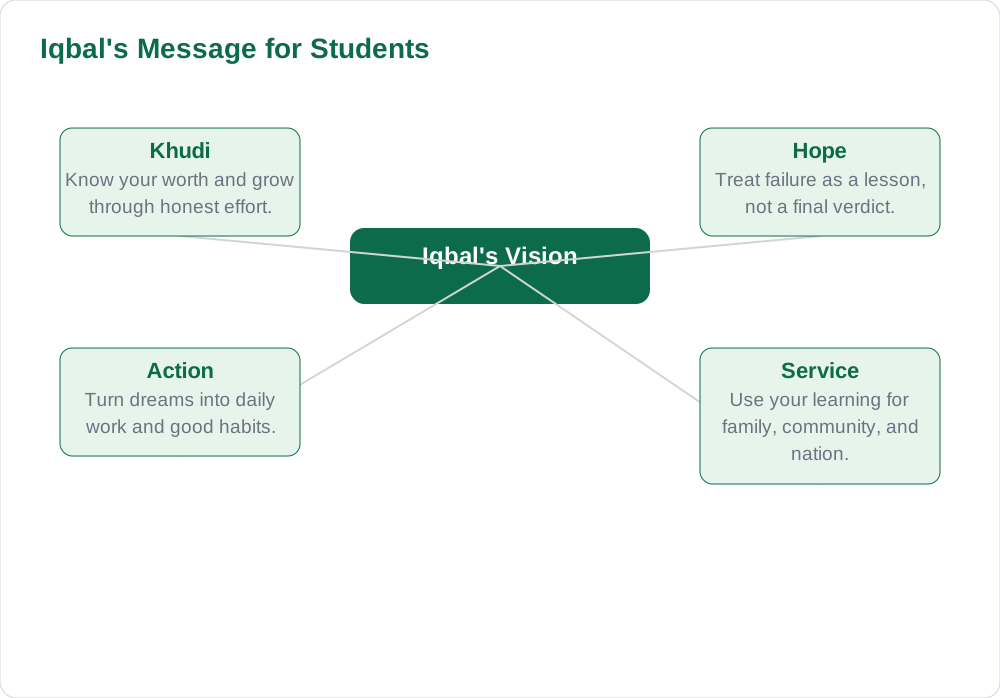
Khudi is often translated as selfhood or ego, but Iqbal did not mean pride or selfishness. He meant a strong, responsible self: a person who knows their strengths, works on their weaknesses, and does not beg for respect. A student with khudi does not copy homework to look clever. Such a student admits what is difficult, practises it, and improves honestly. Khudi also means not blaming others for every failure. When a result is poor, a strong self asks what to change next time: more revision, better notes, or earlier sleep before the exam.
Khudi grows through action. Iqbal praised the eagle, the shaheen, because it flies high, lives freely, and hunts with effort rather than depending on others. Students can copy that spirit in small ways: attempting a hard question before asking for the answer, leading a group presentation, or volunteering for a school task. Each honest attempt builds self-respect. Over time, the student stops fearing hard chapters and starts enjoying the challenge of mastering them.
- Attempt hard questions yourself before asking for help.
- Admit weaknesses honestly and make a plan to improve them.
- Do not copy work or depend on others for your success.
Hope: Never Accept Defeat as Final
Iqbal lived in a time when many Muslims of the subcontinent felt weak and hopeless. His poetry answered that feeling with hope and action. He told young people that nations rise when individuals rise. A student who feels behind in class needs the same message. One bad term does not decide your future. With a better timetable, regular revision, and help from teachers, most students can improve steadily. Hope is not empty wishing. It is the decision to work again after failure.
Hope also means looking beyond marks. Iqbal wanted young people to dream big: to become good teachers, doctors, engineers, writers, and honest citizens. A student should have a dream beyond the next test. Write down what you want to become and what good you want to do for your family and community. Then connect daily study to that dream. When study has a purpose, even boring chapters feel meaningful, because each page is a step toward the person you want to be.
The Dream of Pakistan and the 1930 Address
In 1930, Iqbal delivered his famous Allahabad address, in which he presented the idea of a separate homeland for the Muslims of the north-western subcontinent. This was a vision, not yet a detailed political plan, but it gave direction to later leaders including Quaid-e-Azam. Students should understand this sequence: first an idea, then debate, then organisation, then struggle, and finally a nation. Big change starts with clear thinking. That is why Iqbal is remembered as a visionary. He saw a future that others had not yet imagined.
For students, the lesson is to think ahead. Do not only react to homework and tests. Think about your goals for the year, your strengths, and the kind of person you want to become. Discuss ideas with teachers and elders, read good books, and form your own reasoned opinions. Vision without work is only a dream, but work without vision has no direction. Iqbal combined both: deep thought and a call to action. Explore more subject guidance on the books page.
How to Read Iqbal as a Student Today
Many students find Iqbal's poetry difficult because of its rich Urdu and Persian vocabulary. The way to enjoy it is to start small. Read one couplet at a time with a teacher's explanation. Ask what image the poet uses and what lesson it gives. For example, when Iqbal praises the shaheen, ask yourself what high flying means in student life: aiming high, working independently, and refusing to settle for easy comfort. Keep a notebook of favourite couplets and write one line about what each one teaches you.
You can also connect Iqbal to your own subjects. His call to action fits science experiments, his love of learning fits history and literature, and his message of self-respect fits Islamiat and social studies. Poetry is not separate from real life. It is a way of thinking about courage, purpose, and character. A student who reads Iqbal slowly and thoughtfully will gain more than exam marks. Such a student gains a voice, a direction, and the courage to keep improving. Find more reading guidance on the blog home.
- Read one couplet at a time and note its lesson in your own words.
- Keep a small notebook of favourite verses and their meanings.
- Connect Iqbal's ideas to science, history, and daily school life.
AI Help: Muse AI
Muse AI is Meta's personal AI assistant. It can explain difficult poetry in simple words, summarise a lesson, and create practice questions for revision. For this article, you can ask Muse AI to explain khudi in one simple everyday example for students. Join Muse with invite code LTGSWD — in the Muse app, go to Settings > Redeem token and enter the code. Disclosure: LTGSWD is the author's Muse invite code. Muse AI does not give official Sindh Textbook Board answers — always verify against your Sindh Textbook Board book and your teacher.
4 key points you must know
- Khudi means a strong, responsible self, not pride or selfishness.
- Hope means working again after failure instead of giving up.
- Iqbal's 1930 address gave direction to the idea of Pakistan.
- Read poetry slowly, one couplet at a time, and note its lesson.
Frequently asked questions
What does khudi mean in Iqbal's poetry?
Khudi means selfhood: knowing your worth, developing your talents, and taking responsibility for your life through honest effort rather than depending on others.
Why is Iqbal called the Poet of the East?
His Urdu and Persian poetry combined deep philosophy with a message of self-respect, hope, and action, and it inspired Muslims of the subcontinent and readers far beyond it.
What was important about Iqbal's 1930 Allahabad address?
In it, Iqbal presented the vision of a separate homeland for Muslims of the north-western subcontinent, giving direction to the later Pakistan Movement.
How can a student start reading Iqbal easily?
Start with one couplet at a time, read a simple explanation, note the image and lesson in your own words, and discuss it with a teacher or friend.
Solved notes — preview free
These guides work best with the solved exercises. Preview the solved notes free on this website — 119 solved notes for Classes 6–10 in Sindhi, Urdu, English and Arabic medium. Or browse the full solved notes catalogue for your class and medium. New solved notes are added regularly — check the catalogue for coming-soon books.