After the Matric Science Result: College Admission Next Steps

The Matric Science result is out, and the next question is already waiting: which college, and which stream? The Board of Secondary Education Karachi announced the SSC Part II Class 10 Science Group Annual Examination 2026 result, with about 175,200 candidates appearing and about 141,688 passing, about 80.87 percent. If you are among those who passed, your next decisions matter as much as your result, because the stream you choose now shapes your Class 11 and 12 subjects, your examination preparation, and your options after Intermediate. This article gives you a calm, general plan: how to take stock of your result, how to choose between Pre-Medical, Pre-Engineering, Computer Science, Commerce, and Arts, which documents you usually need, and how college admission timelines work. It invents no college admission dates or merit cut-offs, because those are announced by individual colleges.
First, Take Stock of Your Matric Science Result
Before you choose a college or a stream, spend one quiet evening with your result card. Write down your marks in each subject, your total, and your grade. Then write down your three strongest subjects and your two weakest, and ask yourself an honest question: did your marks reflect your interest, your preparation, or the difficulty of the paper? A student who scored highly in Biology and Chemistry because they loved those subjects has a different signal from a student who scored highly in them through last-minute cramming. Your interests and your steady strengths matter more than a single paper's surprise.
Also write down what you want to do after Intermediate, even if only in broad terms. Do you see yourself in a medical or health field, in engineering or technology, in computing, in business or commerce, or in humanities and arts? You do not need a final career decision at fifteen or sixteen, but a rough direction helps you choose a stream that keeps doors open. A stream chosen without any direction often leads to a change of stream later, which costs time and confidence. If you are unsure, talk to a teacher who knows your work, because teachers see patterns in students' strengths that students themselves often miss.
- Write down marks in each subject, total, and grade
- Note three strongest subjects and two weakest subjects
- Ask whether marks reflected interest, preparation, or paper difficulty
- Write a rough direction for after Intermediate, even in broad terms
Choosing Your Stream: Pre-Medical, Pre-Engineering, Computer Science, Commerce, or Arts
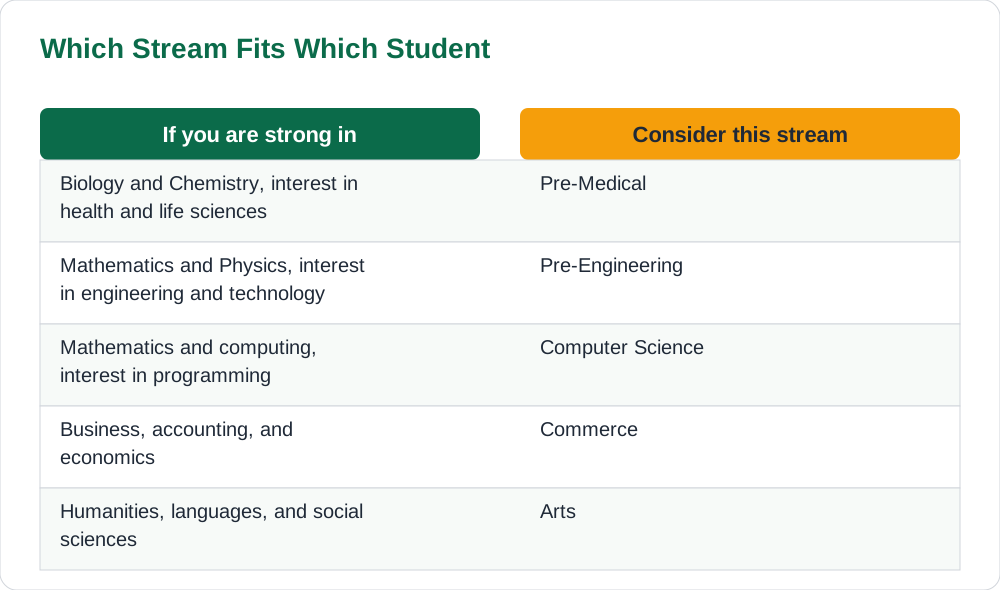
After Matric Science, the five broad streams most students consider are Pre-Medical, Pre-Engineering, Computer Science, Commerce, and Arts. Pre-Medical suits students who are strong in Biology and Chemistry and interested in medical, health, or life-science fields. Pre-Engineering suits students who are strong in Mathematics and Physics and interested in engineering, technology, or physical sciences. Computer Science suits students who enjoy Mathematics and computing and want to build skills in programming and technology. Commerce suits students interested in business, accounting, and economics. Arts suits students who want humanities, languages, social sciences, and related fields.
Choose from your subjects and interests, not from pressure. The most common mistake after Matric is choosing a stream because friends chose it, because a relative praised it, or because it sounds prestigious. A stream that fits your strengths will feel demanding but doable. A stream that fights your strengths will feel like a daily struggle, even if it sounded impressive on result day. Read the subject combinations each stream offers, talk to a teacher about what each combination leads to, and imagine yourself studying those subjects for two years. If the picture excites you, the stream is probably right. If it fills you with dread, keep looking.
- Pre-Medical: strong Biology and Chemistry, interest in medical and life sciences
- Pre-Engineering: strong Mathematics and Physics, interest in engineering and technology
- Computer Science: enjoy Mathematics and computing, interest in programming
- Commerce: interest in business, accounting, and economics
- Arts: interest in humanities, languages, and social sciences
Documents You Usually Need for College Admission
Colleges usually ask for a set of documents with your admission application, and gathering them early saves last-minute stress. The usual list includes your Matriculation result card or mark sheet, your school leaving or character certificate as your school provides it, copies of your national identity documents as the college requires, and passport-size photographs. Some colleges also ask for domicile or other documents depending on their rules and the admission category. The exact list varies by college, so always confirm it against the admission notice of the college you are applying to, rather than relying on a friend's list from a different college.
Prepare your documents now, while the result is fresh. Keep originals in one safe folder and photocopies in another, and keep a digital copy of each document on your phone as a backup. Check that names, dates, and roll numbers match across your documents, because a mismatch can delay admission. If any document is missing or has an error, ask your school about the correction process early, rather than discovering the problem on the last day of admission. For the result itself, see our guide on how to check the BSEK Matric Science result and keep a printed copy of your result card with your documents.
- Matriculation result card or mark sheet
- School leaving or character certificate as your school provides it
- National identity documents as the college requires
- Passport-size photographs and any domicile or category documents the college asks for
- Confirm the exact list against your chosen college's admission notice
How College Admission Timelines Work
College admission timelines are announced by individual colleges, and they differ from college to college. There is no single admission date for all of Karachi, and this article deliberately gives no college admission dates or merit cut-offs, because inventing them would mislead students. The general pattern is that colleges announce admissions after the Matric result, publish their own notices with forms, deadlines, and requirements, and process applications in rounds or merit lists according to their own rules. Your job is to follow the notices of the colleges you actually want, and to meet their deadlines.
Build a simple tracking habit. Make a list of the colleges you want, and for each one note where its admission notice appears, what its deadline is once announced, and what documents it asks for. Check those sources regularly, and apply well before the deadline rather than on the last day, because websites slow down and offices get crowded at the end. If a college has not yet announced admissions, wait for its notice rather than trusting a forwarded date. And if you are also considering improvement or rechecking, read our guide on how scrutiny and rechecking work in Sindh before you let those processes delay your admission planning.
- Timelines are announced by individual colleges and differ by college
- No single admission date or merit cut-off applies to all colleges
- Track each chosen college's notice, deadline, and document list
- Apply well before the deadline, not on the last day
Starting Class 11 Well: What to Do in Your First Month
Once admission is settled, your first month in Class 11 sets the tone for two years. Start by reading the first chapter of each new subject before it is taught, so the teacher's explanation lands on prepared ground. Build a daily routine that covers every subject, not only your favourites, because Intermediate rewards balanced preparation across all papers. Keep a notebook of formulas, definitions, and points you forget, and revise it every evening. And practise writing answers from the first week, because Intermediate papers reward clear, complete, well-organised answers, not only correct final numbers.
Use your STBB textbooks and Solved Notes as your base, and ask teachers early about anything that confuses you. The students who struggle most in Intermediate are often those who waited three months to ask for help, by which time the gap had grown. A question asked in week one is a small fix. The same question asked in month four is a large repair. If you chose Pre-Medical, Pre-Engineering, or Computer Science, give extra time to the subjects you found hardest in Matric, because those subjects only get deeper. If you chose Commerce or Arts, give extra time to writing practice, because clear written expression is the skill that carries those streams.
- Read the first chapter of each subject before it is taught
- Build a daily routine covering every subject, not only favourites
- Keep a notebook of formulas and points you forget; revise it nightly
- Ask for help in week one, not month four
AI Help: Muse AI
Muse AI is Meta's personal AI assistant, and it can help you plan your next step after Matric by explaining what each college stream involves in simple words, or by summarising a Class 11 chapter before you start it.
Join Muse with invite code LTGSWD — in the Muse app, go to Settings > Redeem token and enter the code.
Disclosure: LTGSWD is the author's Muse invite code.
Muse AI does not give official STBB answers — always verify against your Sindh Textbook Board book and your teacher.
5 key points you must know
- After the Matric Science result, take stock of your subject-wise marks before choosing a stream.
- Streams to consider: Pre-Medical, Pre-Engineering, Computer Science, Commerce, and Arts.
- Choose a stream from your strengths and interests, not from peer pressure.
- Gather the documents colleges usually ask for and confirm the exact list per college.
- College admission timelines are announced by individual colleges; no single date applies to all.
Frequently asked questions
Which stream should I choose after Matric Science?
Choose from your strengths and interests. Pre-Medical suits strong Biology and Chemistry, Pre-Engineering suits strong Mathematics and Physics, Computer Science suits computing interest, Commerce suits business interest, and Arts suits humanities interest. Talk to a teacher before you decide.
What documents do colleges usually ask for?
Colleges usually ask for your Matriculation result card, school leaving or character certificate, national identity documents as required, photographs, and any domicile or category documents. Confirm the exact list against your chosen college's admission notice.
When do college admissions open after the Matric result?
Admission timelines are announced by individual colleges and differ by college. This article gives no invented dates or merit cut-offs. Follow the notices of the colleges you want and apply well before their deadlines.
What if I want to improve my Matric marks before college?
Learn how improvement and scrutiny and rechecking work in Sindh before you decide, and do not let those processes make you miss college admission deadlines.
How should I start Class 11 well?
Read the first chapter of each subject early, build a daily routine covering every subject, keep a notebook of forgotten points, and ask for help in week one. Use your STBB textbooks as the base for every subject.
Solved notes — preview free
These guides work best with the solved exercises. Preview the solved notes free on this website — 119 solved notes for Classes 6–10 in Sindhi, Urdu, English and Arabic medium. Or browse the full solved notes catalogue for your class and medium. New solved notes are added regularly — check the catalogue for coming-soon books.