Active Recall: Testing Yourself with the Book Closed
Most pupils revise by reading a chapter again and again, and most pupils are surprised when the exam paper feels unfamiliar. The reason is simple: reading feels easy, so it feels like learning, but it only trains your eyes to recognise words that are already in front of you. Active recall works the opposite way. You close the book, ask yourself a question, and try to produce the answer from memory before you look. That effort of pulling an answer out of your head is what strengthens the memory itself, so the answer is there again when the exam asks for it. This article explains a closed-book routine you can use for any subject, starting tonight, with nothing more than your notebook and a pen.
Why Re-reading Feels Easy and Fails
Re-reading creates a comfortable illusion. When the answer is sitting on the page, your brain recognises it and mistakes that recognition for knowledge, so you turn the page feeling confident. In the exam hall, though, there is no page to recognise: the question asks you to produce the answer, not to recognise it. That is a completely different mental job, and it is one that re-reading never practises. Pupils who only re-read often say the paper felt harder than their revision did, and this gap between recognition and recall is exactly why.
Active recall closes that gap by making revision match the exam. Every time you try to answer with the book closed, you practise the same skill the exam will demand: retrieving information without help. The attempt does not have to be perfect to be useful. Even a half-remembered answer that you then correct teaches your brain more than a smooth re-reading of the same page, because the struggle itself marks the information as important. Short, effortful attempts beat long, comfortable reading every time, and they take less time too.
The Closed-Book Routine, Step by Step
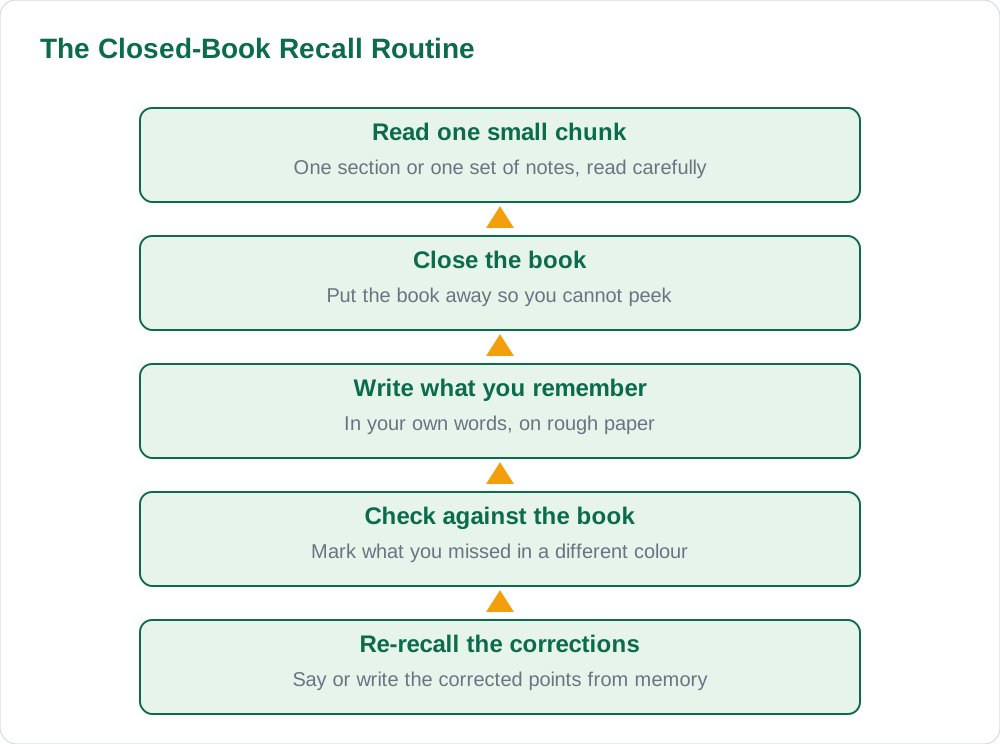
Start with a small chunk, never a whole chapter at once. Read one section or one set of notes carefully, then close the book and write down everything you can remember about it, in your own words, without peeking. Use rough paper or the back of your notebook so the attempt feels low-pressure; this is practice, not a test, and messy recall is perfectly fine. Give yourself a few minutes of genuine effort before you open the book again, because the benefit comes from the trying, not from getting everything right first time.
Now open the book and check your recall against the original, marking what you missed or got wrong in a different colour. Do not just read the corrections: say them aloud or write them again from memory, so the corrected version gets its own retrieval attempt. Then move to the next small chunk and repeat the cycle. A single study session built this way covers less ground than a re-reading session, but what it covers actually stays with you, which is why it saves time over the whole week. You can find more study methods on the blog and in the book collection.
What to Do When You Cannot Recall Anything
A blank mind during recall is not a failure; it is useful information. It tells you exactly which part of the chapter has not been learned yet, and that is far more valuable than a vague feeling that you sort of know it. When you draw a blank, do not sit staring at the page for ten minutes. Open the book, re-read just that small part, close it again, and try once more. Two or three short attempts with checking in between will fix a fact far better than one long stare at the open page.
If the same point keeps slipping away, change how you store it instead of repeating the same failed attempt. Turn it into a question you can ask yourself, connect it to something you already know, or break it into smaller pieces. Pupils often find that the points they struggled most to recall are the ones they remember best in the exam, because the effort spent on them made the memory stronger. Keep a short list of your stubborn points and return to them first in your next session, rather than starting again from the beginning of the chapter.
Using Closed-Book Recall in Every Subject
Active recall adapts to any subject because every subject has something to retrieve. In Islamiat or history, recall the main points of a lesson and the order in which events or ideas follow each other. In science, close the book and write the steps of a process, the parts of a diagram, or the meaning of a term from memory. In mathematics, cover the worked example and try to solve the problem yourself before looking at the solution, because reading a solution feels like understanding it even when you could not produce it alone.
For language subjects, recall works beautifully with vocabulary and grammar. Cover the meanings and try to write them, or read a sentence in one language and reproduce it in the other. The method also works in pairs: one pupil asks questions from the notes while the other answers with the book closed, then they swap roles. Pair recall adds a gentle pressure that feels like exam pressure, which makes it excellent preparation. Browse the solved notes for material to practise with, and start with short sessions of twenty minutes before building up.
- Islamiat and history: recall lesson points and their order from memory.
- Science: recall process steps, diagram parts, and term meanings with the book closed.
- Mathematics: cover the worked example and solve the problem yourself first.
- Languages: cover meanings and reproduce vocabulary or sentences from memory.
- Pair work: take turns asking and answering questions with the book closed.
Building Recall Into Your Daily Revision
Recall works best as a daily habit, not as a last-minute technique. Begin each study session by recalling yesterday's topic before opening today's chapter, because that short warm-up both revises old work and tells you what needs another look. End each session the same way: close everything and spend five minutes writing down the main points of what you just studied. Those two bookends turn every session into a recall session without adding much time, and they stop the common problem of learning a chapter and then never returning to it.
Keep the sessions short and regular rather than long and rare. Twenty to thirty minutes of closed-book recall, done most days, will beat a three-hour re-reading marathon before the exam, because memory grows through repeated retrieval spread over days. Track your progress simply: note which topics you recalled well and which needed checking, and let that list decide tomorrow's session. Over a few weeks, the list of weak topics shrinks, and that visible progress is one of the most motivating sights in revision. More practical guidance is on the [home page](/) and the blog.
AI Help: Muse AI
Muse AI is Meta's personal AI assistant. You can ask it to explain a concept in simple words, summarise a lesson, or make practice questions for revision.
For active recall, ask Muse AI to turn a chapter summary into short quiz questions you can answer with the book closed, then check your answers against your notes afterwards.
Join Muse with invite code LTGSWD — in the Muse app, go to Settings > Redeem token and enter the code.
Disclosure: LTGSWD is the author's Muse invite code.
Muse AI does not give official STBB answers — always verify against your Sindh Textbook Board book and your teacher.
5 key points you must know
- Close the book and try to produce answers from memory before checking.
- Work in small chunks: read one section, recall it, check it, then move on.
- A blank recall is useful information, not failure: re-read the small part and try again.
- Use recall in every subject, from science processes to language vocabulary.
- Start each session by recalling yesterday's topic and end by recalling today's.
Frequently asked questions
What is active recall in simple words?
Active recall means trying to remember an answer before looking at it. You close the book, ask yourself a question, and produce the answer from memory. The effort of retrieving the answer is what makes the memory stronger.
How is active recall different from re-reading?
Re-reading trains recognition, because the answer is already in front of you. Active recall trains retrieval, which is what an exam actually requires. That is why re-reading can feel confident yet fail in the exam hall.
What should I do if I cannot recall anything at all?
Treat the blank as useful information. Re-read just that small part, close the book, and try again. Two or three short attempts with checking in between will fix a fact better than staring at the open page.
How long should a recall session last?
Twenty to thirty minutes of focused recall is enough for one session, done most days. Short, regular sessions beat long, rare ones, because memory grows through repeated retrieval spread over days.
Can I use active recall with a study partner?
Yes, pair recall works very well. One pupil asks questions from the notes while the other answers with the book closed, then they swap roles. The gentle pressure of answering aloud feels like exam pressure and is excellent preparation.
Solved notes — preview free
These guides work best with the solved exercises. Preview the solved notes free on this website — 119 solved notes for Classes 6–10 in Sindhi, Urdu, English and Arabic medium. Or browse the full solved notes catalogue for your class and medium. New solved notes are added regularly — check the catalogue for coming-soon books.